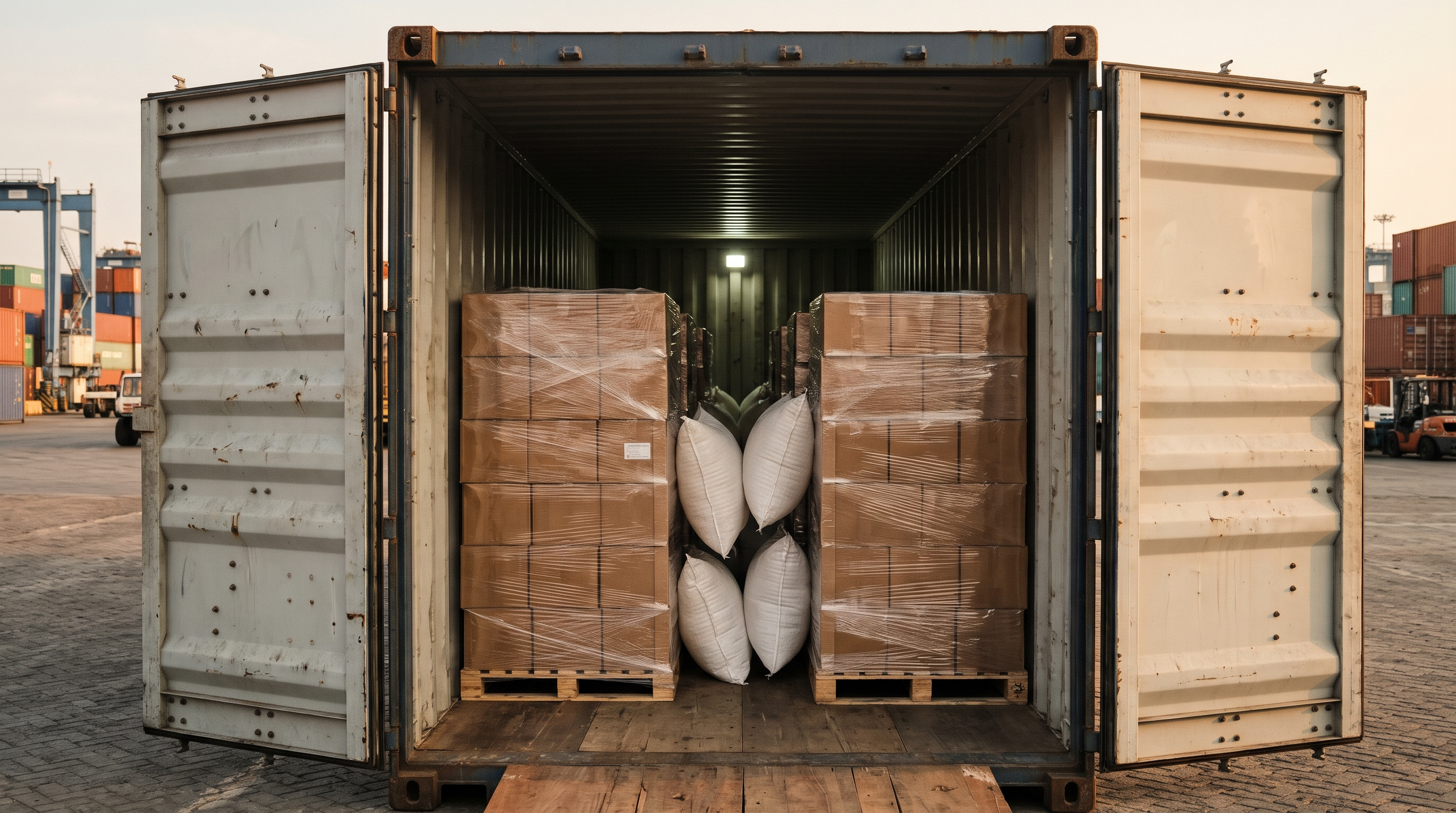
Container Dunnage: Types and How to Secure a Shipping Container
A shipping container is a steel box that is lifted by cranes, stacked on ships, rolled by waves, braked on trucks and shunted on rail wagons. Cargo inside it will move if it has room to move. Container dunnage is everything you put into a container to fill the empty space and hold the cargo still, and choosing the right type for each gap is the cheapest insurance against transit damage.
This guide covers why cargo shifts in containers, the main types of container dunnage, where each one works best, how to plan the dunnage for a load, and a checklist for your loading team.
Why cargo shifts inside a container
A container journey combines several kinds of movement:
Sea motion. A ship rolls, pitches and heaves for days. Every movement pushes the cargo sideways, forwards and back.
Road transport. Braking, cornering and potholes push the load against the doors and walls.
Rail shunting. Wagons are coupled and uncoupled with sharp jolts along the length of the container.
Crane handling. Containers are lifted, swung and set down at every port and terminal.
If there is a gap between the cargo and the container wall, or between two parts of the load, the cargo builds speed across that gap before it hits something. That impact is what crushes cartons, breaks pallets, dents drums and tips machinery. The aim of dunnage is to remove the gaps so the load and the container move as one.
The main types of container dunnage
Type | Best for | Limitations |
|---|---|---|
Inflatable dunnage bags (air bags) | Gaps between pallets, stacks and rows | Need correct sizing and inflation |
Timber blocking and bracing | Very heavy, dense items such as machinery and steel | Heavy, slow to fit, export wood needs ISPM 15 |
Corrugated board, edge and corner protectors | Protecting corners and spreading strap pressure | Lose strength if wet |
Foam and void-fill | Small spaces around fragile items | Bulky; not for large voids |
Lashing straps and chains | Tying cargo to the container's lashing points | Do not fill voids on their own |
Anti-slip sheets | Increasing friction between layers and the floor | Do not stop large movements on their own |
Most container loads use several of these together: straps or lashing to tie the load down, anti-slip sheets to reduce sliding, and dunnage bags or blocking to fill the gaps.
Inflatable dunnage bags: the most common choice
Inflatable dunnage bags are the most widely used container dunnage for palletised and mixed cargo because they:
Fill irregular gaps and press evenly on both faces
Weigh very little compared with timber
Fit in seconds with a standard inflation tool
Avoid wood treatment rules, since they are not solid wood packaging
Shish's Stuffex dunnage bags are built with a multi-layer co-extruded polyethylene inner bladder and an outer shell of kraft paper or woven polypropylene. They come in light, medium and heavy-duty grades, with burst pressures from 0.2 to 0.6 bar depending on grade, and in standard sizes of 36" × 48", 36" × 72" and 48" × 96", with custom sizes available.
For a deeper explanation of how they work, see our air dunnage bags guide.
Paper or woven PP?
Paper dunnage bags suit medium-duty, dry loads.
Woven PP dunnage bags suit heavy-duty loads and shipments exposed to moisture, including container condensation on long sea voyages.
Our paper vs polywoven guide compares them in detail.
Timber: still right for some loads
Timber blocking and bracing are still the right choice for very heavy point loads, such as machinery, steel coils and large castings, where the cargo must be fixed to the floor and walls rather than cushioned.
Two things to remember:
Timber is heavy. It adds weight that counts towards the container's payload limit.
Export wood must meet ISPM 15. Solid wood packaging in international trade must normally be heat-treated or fumigated and marked. Our export packaging guide explains the rule.
For many palletised loads, dunnage bags do the same job as timber in the gaps between pallets, with less weight and less labour.
Where the gaps are, and what fills them
Gap | Typical cause | Usual dunnage |
|---|---|---|
Between two rows of pallets | Pallets do not fill the container width exactly | Dunnage bag sized to the gap |
At the end of the load, near the doors | The load does not fill the container length | Dunnage bags between the last rows, plus blocking or a load barrier |
Between stacks of different heights | Mixed cargo | Dunnage bags, with board protecting the softer face |
Around a single heavy item | Machinery, crates | Timber blocking and lashing |
Small spaces around fragile goods | Odd-shaped products | Foam or void-fill |
Never rely on a dunnage bag pressing directly against the container doors. If the doors are opened with the bag inflated, the load can push outwards. Place the bags between rows of cargo, and use blocking or a load barrier at the door end. Our installation guide explains placement in detail.
How to plan the dunnage for a container
Plan the load. Work out how pallets or cartons will sit in the container and where gaps will remain. A simple drawing is enough.
Measure the expected gaps. Width and height of each void between rows and at the door end.
Choose the dunnage type for each gap. Bags for gaps between pallets and stacks; timber for heavy point loads; foam for small spaces.
Choose the bag grade and size. Match the grade to the weight pressing on the bag, and the size to the gap. Our dunnage bag sizes guide shows how.
Order a little spare. Loads rarely go exactly to plan, and an extra bag costs far less than a damaged pallet.
Brief the loading team so the plan is followed on the day.
Rail containers and AAR certification
If the container travels on rail in North America, the dunnage bags used may need to meet AAR (Association of American Railroads) requirements. Shish offers AAR-certified rail-grade Stuffex bags. Our AAR dunnage bags guide explains when this applies.
Container loading checklist
[ ] Container inspected: clean, dry, no holes, doors seal properly
[ ] Load plan agreed, with the gaps marked
[ ] Heavy items at the bottom and spread across the floor
[ ] Cargo stacked tightly and squarely
[ ] Anti-slip sheets or lashing fitted where planned
[ ] Dunnage bags placed away from sharp edges, flat and centred in each gap
[ ] Bags inflated to the recommended pressure for their grade
[ ] No bag pressing directly against the doors
[ ] Load checked for movement before the doors are closed
[ ] Receiving team told that the container has dunnage bags to deflate before unloading
Common container dunnage mistakes
Leaving the door gap empty. The last rows of cargo are the most likely to move.
One bag for a gap that is too wide. Over-inflating a small bag to fill a large gap stresses the bag and the cargo.
Bags against nails, staples or strap buckles. These puncture the bag. Put a piece of board between the bag and the hazard.
Wet paper bags. In humid routes or long voyages, choose woven PP.
Untreated wood for export. It can be refused at the destination.
Stuffex container dunnage bags from Shish
Shish SmartPack manufactures Stuffex air dunnage bags in Surat, India, for shipping containers, trucks and trailers, rail, air cargo and warehousing. Options include paper or woven PP shells, light to heavy-duty and AAR rail grades, standard fast-fill or reusable valves, smooth or anti-slip surfaces, custom sizes and custom printing. The materials are 100% recyclable.
See the full specifications on the air dunnage bags product page, and our certifications on the certifications page.
Frequently asked questions
What is container dunnage?
Container dunnage is any material placed inside a shipping container to fill empty space and stop the cargo moving. Common types are inflatable dunnage bags, timber blocking, corrugated board, foam and anti-slip sheets.
What is the best dunnage for a shipping container?
For palletised and mixed cargo, inflatable dunnage bags are the most common choice because they are light, quick to fit and fill irregular gaps. Very heavy point loads such as machinery are better secured with timber blocking and lashing.
How many dunnage bags does a 20 ft or 40 ft container need?
It depends on the load plan, not the container size. Count the gaps between rows and at the door end, and plan one correctly sized bag per gap. A load plan drawing makes this easy.
Can dunnage bags be placed against the container doors?
No. A bag pressing on the doors can push the load out when the doors are opened. Place bags between rows of cargo, and use blocking or a load barrier at the door end.
Does container dunnage need ISPM 15?
Only solid wood dunnage does. Paper and plastic dunnage bags, foam and corrugated board are not covered by ISPM 15.
Paper or woven PP dunnage bags for sea freight?
Woven PP is the safer choice for long sea voyages, heavy loads and humid routes, because it resists moisture and condensation. Paper bags suit medium-duty, dry loads.
Plan the dunnage for your next container
Send us your container type, what you are shipping and a rough load plan. Our team will recommend the dunnage type, bag grade, size and quantity, and quote against a specification you can check.
