Dunnage Bag Sizes & Level Ratings: A Selection Guide
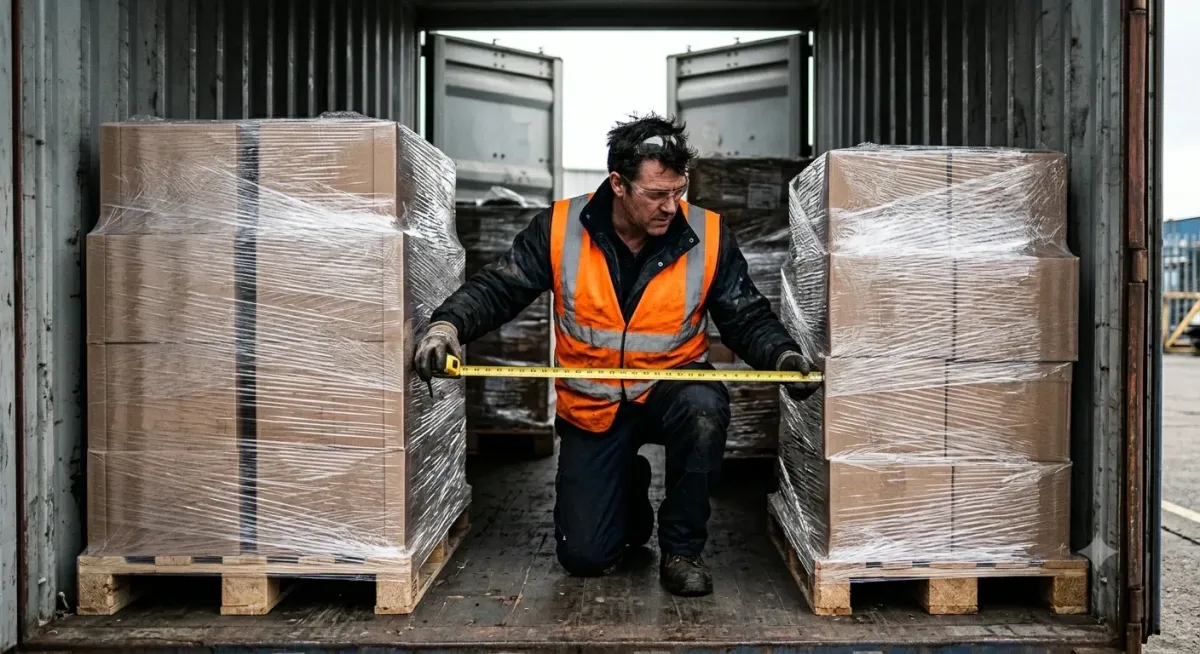
Dunnage Bag Sizes: How to Measure Your Void and Choose Correctly
Choosing a dunnage bag comes down to two numbers: the size of the void you are filling, and the force the bag has to hold back. Get the void measurement wrong and even a premium bag will fail — the single most common cause of transit damage is a bag sized to the gap rather than larger than it.
This guide covers how to measure a void correctly, what the standard sizes are, how to match a level rating to your load, and how to work out how many bags a container actually needs.
If you want the background on how these bags work before selecting one, start with our guide to air dunnage bags.
Measure the void, not the pallet
The void is the empty space between two cargo faces, or between cargo and the container wall. It sounds obvious, and it is still where most people go wrong.
Three rules:
Measure at the widest point. Voids are rarely parallel. Pallets lean, stretch wrap bulges, container walls are not perfectly straight. A bag sized to the narrowest point will be loose everywhere else, and a loose bag does nothing.
Measure after the load has settled, not as you stow it. A stack that is 150 mm from the wall when loaded can be 200 mm away once the truck has moved. Where you can, measure a completed load of the same configuration.
Measure the height of the cargo faces too. The bag needs to brace across a meaningful proportion of the stack height. A short bag between two tall pallets lets the load tip over the top of it.
Why the bag must be bigger than the void
A dunnage bag works by being in compression. If the inflated bag exactly matches the void, it is merely touching both faces — it is not pressing against them, and the moment the load settles a few millimetres the bag is loose.
As a working rule, the bag's rated void width should be comfortably above your measured gap, so the bag is still in compression at full inflation. Suppliers publish a rated void range for each size; your measured void should sit in the middle of that range, not at the top of it.
Sizing to the very top of a bag's rated range is a false economy. You save nothing meaningful and you lose all your margin for the load settling.
Standard sizes
Dunnage bags are sold in a set of conventional sizes. Export trade still quotes in inches; Indian domestic supply often quotes in millimetres. Both describe the same products.
Inches | Millimetres (approx.) | Typically used for |
|---|---|---|
36 x 48 | 900 x 1200 | Narrow side voids, small gaps between pallet rows |
36 x 72 | 900 x 1800 | Side voids on taller stacks |
48 x 48 | 1200 x 1200 | Square voids between pallet rows |
48 x 72 | 1200 x 1800 | The most widely used general-purpose size |
48 x 96 | 1200 x 2400 | Full-height bracing across a container width |
60 x 96 | 1500 x 2400 | Large voids, oversized or part-loaded containers |
The first dimension is generally the width of the bag; the second is its length along the cargo face. Confirm orientation with your supplier before ordering in volume — conventions do vary.
Matching the level to the load
Level ratings run from 1 to 5, with higher numbers meaning greater strength and working pressure. As covered in the previous guide, these ratings are an industry convention rather than a governed standard, so treat them as a starting point and ask for the underlying numbers.
Selection depends on three things together — not weight alone:
Factor | Pushes you up a level |
|---|---|
Cargo weight | Heavier, denser loads |
Transport mode | Rail above sea, sea above road |
Journey length | Longer voyages, more settling cycles |
A light load on a long rail haul can need a higher level than a heavy load on a short road trip. Coupling impacts in rail transport generate forces that road transport simply does not produce, which is why rail is treated separately and has its own certification regime.
When you are between two levels, go up. The cost difference per bag is small relative to a damaged consignment.
How many bags does a container need?
There is no reliable per-container figure, and any supplier who gives you one without seeing your load is guessing.
The method that works:
Draw or photograph the stow plan for the container.
Identify every void wider than roughly 100 mm — between pallet rows, along both side walls, and at the door end.
Size a bag for each, measured at its widest point.
Decide the level from cargo weight, mode and journey length.
Add a small contingency for voids that open up as the load settles.
Most loaders find the number is higher than they expected the first time, and then stable across every subsequent shipment of the same configuration. The planning cost is one-off.
Five sizing mistakes worth avoiding
Sizing to the narrowest point of the void. Covered above, and still the most common error.
Using one size for everything. Side voids and row voids are rarely the same width. A single-size order is convenient to buy and expensive in damage.
Ignoring cargo face height. A bag that braces only the bottom third of a tall stack invites the load to tip.
Choosing level by weight alone. Mode and journey length matter as much.
Bracing against the container doors. Pressure transfers to the door locking bars and makes the container unsafe to open at destination. Never do this, at any size or level.
Specifications to confirm before ordering
Bag dimensions, and which dimension is width
Rated void width range — not a single figure
Recommended working pressure and burst pressure
Outer material and GSM, inner bladder layers
Valve type and inflation time
Reusable or single-journey, with a rated cycle count if reusable
Shish manufactures air dunnage bags across light, medium and heavy duty grades with woven polypropylene or kraft paper outers, in standard and custom sizes. Specifications are on the air dunnage bags page.
Frequently asked questions
What is the most common dunnage bag size?
48 x 72 inches — roughly 1200 x 1800 mm — covers the majority of general palletised freight in standard containers. It is a sensible default to start from, but it should not be your only size unless your loads genuinely never vary.
Can I use one large bag instead of two smaller ones?
Sometimes, but not usually. Two correctly placed bags distribute pressure across more of the cargo face and give you redundancy if one fails. One oversized bag concentrates force in a single area, which can damage the packaging it is bracing.
How do I know if a bag is the right size once it is inflated?
It should be visibly compressed against both cargo faces, with no slack anywhere along its length, and it should take some effort to push a flat hand into the gap at the edge. If you can slide a hand in easily, the bag is undersized for that void.
Do dunnage bags come in custom sizes?
Yes, and for repeat shipments with an unusual stow pattern it is often worth it. If the same awkward void appears on every container you ship, a bag made to that dimension costs little more than a standard size and performs better than forcing a near-fit.
Does bag size affect the inflation pressure?
The working pressure is set by the bag's construction and level, not its dimensions — but a larger bag takes longer to reach that pressure. On a container with twenty bags, valve type matters more to your loading time than size does.
Get a sizing recommendation
Send us your stow plan or a photograph of a loaded container and our team will come back with sizes, levels and quantities for that specific configuration — including where you can use a lower level and save money.
Request a sizing recommendation
Or reach the team through the contact page.
