Air Dunnage Bags: Levels, Materials & Loading Guide
Air Dunnage Bags: How They Work, Levels and Container Loading
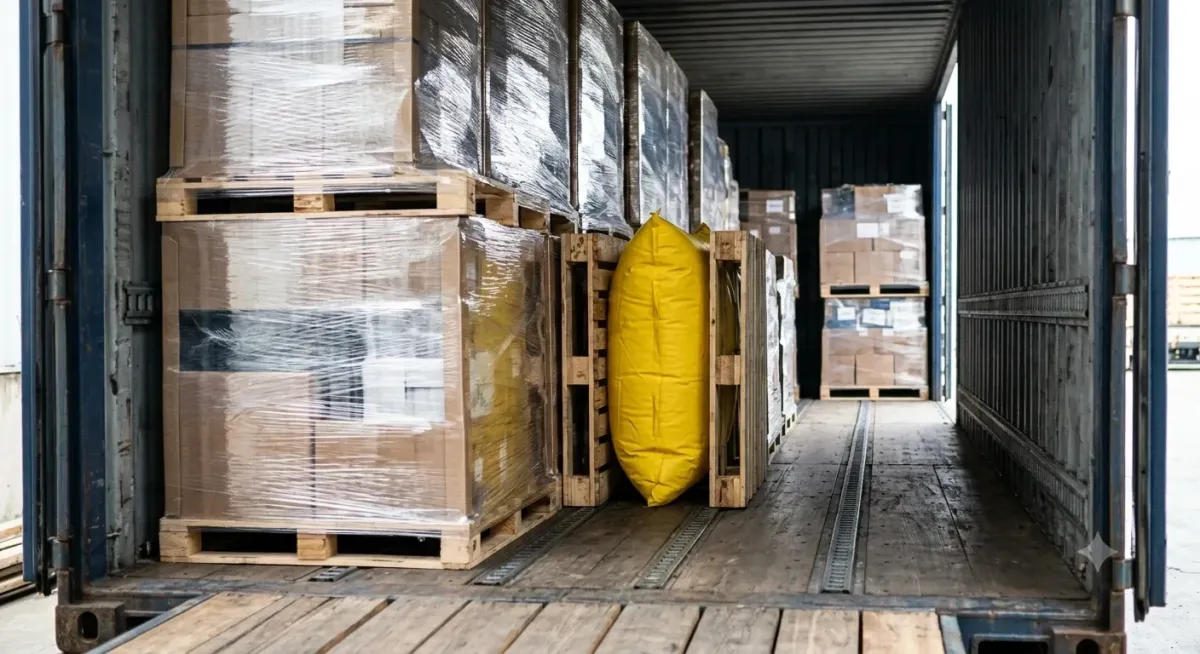
Air dunnage bags are inflatable void fillers placed between cargo units to stop them moving in transit. They work by turning a loose gap into a braced load — the inflated bag presses steadily outward against both faces of the void, so cargo never travels far enough to build momentum. That last part matters more than it sounds: damage in transit is rarely caused by a single violent impact. It is caused by thousands of small movements over hundreds of kilometres.
This guide covers how the bags are built, what the level ratings actually mean, how to place them, and the specifications worth insisting on before you buy.
What an air dunnage bag actually does
A loaded container almost never fills perfectly. You are left with voids — between pallet rows, between the last row and the doors, down the sides where pallet dimensions do not divide evenly into container width.
Those voids are where damage starts. Under braking, cornering and sea swell, cargo slides into the gap, strikes whatever is on the other side, and rebounds. Each cycle loosens stretch wrap, shifts cartons out of column, and transfers load onto packaging that was never designed to carry it.
An inflated dunnage bag removes the gap. It does not simply block movement — it applies continuous pressure, which keeps the stack in compression and stops the load loosening as the journey progresses.
Two practical consequences follow:
A correctly sized bag is slightly larger than the void, not equal to it. It needs to be in compression when inflated.
A bag that has gone soft on arrival has still done its job. Pressure drop over a long voyage is normal, not a defect.
How they are built
Nearly all air dunnage bags share the same two-part construction.
The inner bladder is polyethylene, usually multi-layer. This is the airtight element. Layer count and film thickness drive how well the bag holds pressure over a long journey.
The outer shell carries the load, and comes in two families:
Outer material | Characteristics | Best suited to |
|---|---|---|
Woven polypropylene | Tear resistant, moisture tolerant, reusable | Sea freight, humid routes, return-trip logistics |
Multi-ply kraft paper | Lower cost, recyclable, single journey | Domestic road, dry conditions, one-way shipments |
Woven PP is the more forgiving option. It handles rough container floors, survives contact with sharp pallet corners, and is not weakened by condensation inside a container crossing climate zones. Kraft paper is cheaper per unit and easier to dispose of, but it is a one-way product and it does not like moisture.
The third component people forget is the valve. Inflation and deflation speed is almost entirely a valve question, and on a 40-foot container with twenty bags it is the difference between a twenty-minute job and an hour. Ask to see the valve type before you commit to a supplier.
Understanding level ratings
Dunnage bags are sold by "level" — commonly Level 1 through Level 5, with higher numbers indicating greater strength and working pressure.
Here is the part most buying guides leave out: level ratings are not governed by a single universal standard. One manufacturer's Level 3 is not guaranteed to match another's. The numbering is an industry convention, not a specification you can hold a supplier to.
Broadly, the convention runs:
Level | Typically used for | Common modes |
|---|---|---|
Level 1 | Light void filling, palletised consumer goods | Road, sea |
Level 2 | General palletised freight | Road, sea |
Level 3 | Heavier drums, dense cartons, mixed loads | Road, sea |
Level 4 | Heavy industrial loads, longer voyages | Sea, rail |
Level 5 | Maximum duty, long rail hauls | Rail |
Treat the level as a starting point for conversation, then ask for the numbers underneath it: burst pressure, recommended working pressure, and the void width the bag is rated to fill. Those are comparable across suppliers. The level number is not.
Where they are used
Sea containers — the largest single application. Long duration, constant motion, and voids that open up as the load settles.
Road trailers and trucks — shorter journeys but harsher braking events.
Rail wagons — the most demanding case. Coupling impacts generate forces that road transport never produces, which is why rail has its own certification regime (covered in a separate guide).
Air freight ULDs — less common, and weight-sensitive, so paper outers dominate.
How to place and inflate one correctly
Most failures are placement failures, not product failures.
Measure the void at its widest point. A bag sized to the narrowest point will be loose everywhere else.
Position the bag centrally in the gap, roughly at the vertical mid-height of the cargo faces it is bracing. Too low and the load can tip over the top of it.
Ensure both faces are flat and sound. A dunnage bag braces against the cargo; if it is pressed against a collapsing carton, it will push that carton in rather than hold the stack.
Inflate to the recommended working pressure, not until it looks full. Over-inflation is a real failure mode — it can crush the cargo it is meant to protect and leaves no margin for thermal expansion.
Never place a bag directly against the container doors. Door pressure can make the container dangerous to open at destination.
That last point is worth repeating. A bag braced against the doors transfers its load to the door locking bars. Somebody has to open that container.
What goes wrong, and why
The bag arrives deflated. Usually not a leak — usually under-inflation at origin, or a void that widened as the load settled. Check placement procedure before blaming the product.
The bag burst. Almost always over-inflation, or a level rating too low for the load. Sometimes a sharp edge on adjacent cargo.
Cargo still shifted. The bag was too small for the void, or placed too low, or braced against a face that was not structurally sound.
The bag was unusable on arrival. Paper outer on a humid sea route. Specify woven PP.
Specifications to ask for in writing
Outer material and GSM — woven PP or kraft, and the weight
Inner bladder: number of layers and film thickness
Recommended working pressure and burst pressure, stated as numbers
Rated void width range
Valve type, and inflation and deflation time
Whether the bag is rated reusable, and for how many cycles
Certification where relevant — AAR for rail
Shish manufactures air dunnage bags in light, medium and heavy duty grades, with woven polypropylene or kraft paper outers and AAR-certified rail grade available. Full specifications are on the air dunnage bags page, and our certifications are listed in full.
Frequently asked questions
Can air dunnage bags be reused?
Woven polypropylene bags generally can be, provided the bladder is intact and the outer shows no tearing. Kraft paper bags are single-journey products. If reuse matters to your operation, specify woven PP and ask the supplier for a rated cycle count rather than assuming one.
What pressure should I inflate to?
Whatever the manufacturer states for that specific bag — it varies by level and by size. Inflating "until it feels firm" is the single most common cause of burst bags, because a bag that feels right at 20°C will be significantly over-pressure in a container crossing the tropics.
Do I need AAR-certified bags for sea freight?
No. AAR certification is specific to rail transport in North America. For sea freight you want an appropriate level rating and a woven PP outer. Paying for AAR certification on a purely maritime route is money spent on a requirement you do not have.
What is the difference between paper and woven PP dunnage bags?
Cost and durability. Paper is cheaper and recyclable but single-use and vulnerable to moisture. Woven PP costs more per unit, survives humidity and rough handling, and can be reused. For sea containers crossing climate zones, woven PP is usually the better economics despite the higher unit price.
How many bags do I need per container?
It depends entirely on how your load is configured — there is no useful per-container rule. The practical method is to plan the stow, identify every void over roughly 100 mm, and size a bag for each. Suppliers who know their product will do this with you from a load diagram.
Get a recommendation for your load
If you can share your cargo type, container size and a rough stow plan, our team will come back with a bag size, level and material recommendation — including whether you need AAR grade or not, which often saves money rather than adding it.
Request a recommendation for your load
Or speak to the team directly via the contact page.
