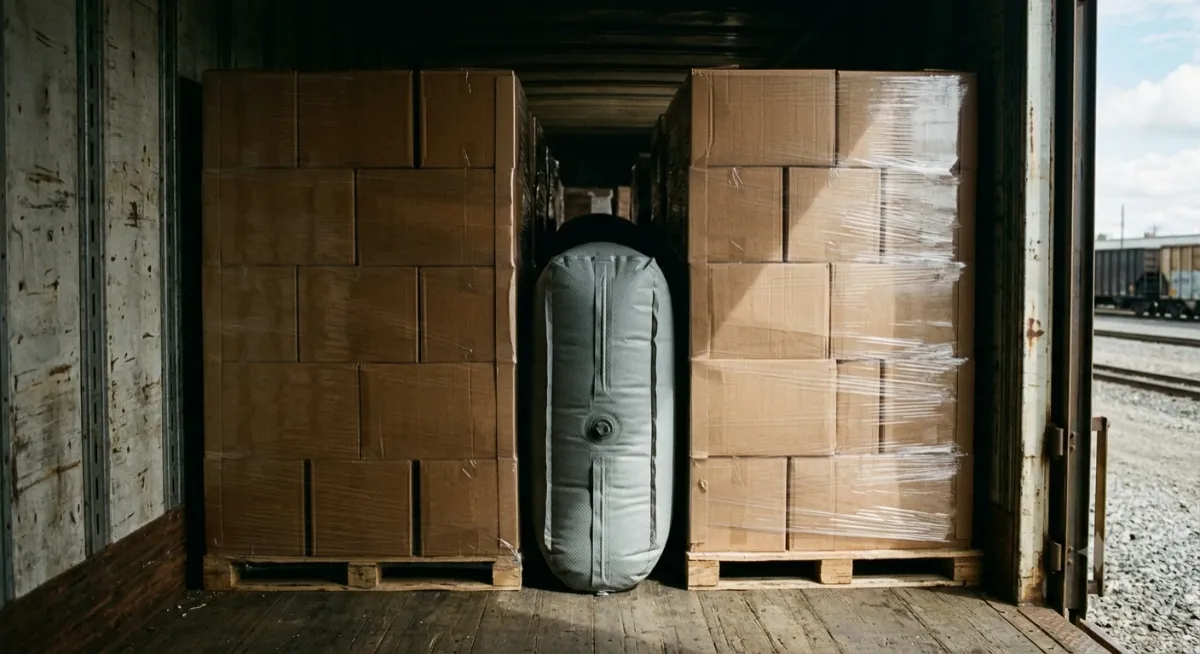
AAR Certified Dunnage Bags: Rail Freight Requirements
AAR-Certified Dunnage Bags for Rail: What Exporters Need to Know
If your cargo travels by rail in North America, the dunnage bags inside it are subject to a certification regime that does not apply to road or sea freight. AAR certification means the bag has been qualified against the Association of American Railroads' requirements for rail transport — and an uncertified bag in a rail shipment can put the consignment, and the claim behind it, in a difficult position.
This guide explains what the certification covers, why rail is treated differently, and what to check on a supplier's paperwork before you buy.
Why rail is a different problem
A truck brakes. A ship rolls. Both produce forces that a well-specified dunnage bag handles comfortably.
Rail produces something else: coupling impact. When wagons are joined in a yard, or a train takes up slack between cars, the load experiences a sharp longitudinal shock in a fraction of a second. Repeat that across a continental journey with multiple switching operations and the cumulative demand on cargo restraint is far beyond anything road transport generates.
This is why a bag that performs perfectly on a sea route can fail on rail. The failure is not a quality problem. It is a specification problem — the bag was never designed for that force profile.
What AAR certification actually is
The Association of American Railroads publishes loading rules for freight moving on the North American rail network. Dunnage and cargo securement in closed cars falls under AAR General Information Series Pamphlet 6, commonly just called Pamphlet 6.
For an air dunnage bag, certification means the product has been tested and approved against those requirements, and carries an AAR approval reference tied to that specific product and specification.
Three things follow that buyers often miss:
Certification is product-specific, not company-wide. A manufacturer holding AAR approval for one bag specification does not automatically have it for every bag they make. Approval attaches to a defined construction.
It is not a quality mark in general terms. An AAR-certified bag is not inherently "better" than a non-certified one for sea freight. It is qualified for a different and more demanding duty.
It is a North American framework. AAR governs rail in the United States, Canada and Mexico. It is not a global rail standard, and it is not a requirement for Indian domestic rail.
Who actually needs it
You need AAR-certified bags if:
Your container moves on the North American rail network at any point, including intermodal legs after a sea crossing
Your customer or freight forwarder specifies compliance with AAR Pamphlet 6
You are shipping in boxcars rather than containers on North American routes
You do not need it if:
Your shipment is sea freight to a port, then road to the consignee
You ship domestically within India
Your route is road-only, anywhere
That last distinction is worth money. AAR-certified bags cost more. Buying them for a purely maritime or road route is paying for a requirement you do not have — which is why a supplier who asks about your route before quoting is more useful than one who simply sells you the highest grade.
The trap is the intermodal leg. A container that crosses the Pacific and then moves inland by rail has a rail leg, even though the shipment feels like sea freight. Check the full routing, not just the first leg.
What to check on the paperwork
Ask for the certificate, not a verbal assurance. Then check:
The approval reference — and that it is current, not expired
The product specification it covers — does it match the bag you are actually being quoted? Size, level, outer material
The manufacturer named — approval belongs to whoever manufactured to that specification
Testing scope — what was tested, and against which revision of Pamphlet 6
If a supplier is reluctant to show the certificate, or shows one covering a different specification from the bag on your quotation, that is the answer to your question.
Specification still matters on top of certification
Certification is a floor, not a selection method. You still have to get the basics right:
Factor | Why it matters more on rail |
|---|---|
Level rating | Rail typically demands the upper levels |
Outer material | Woven PP, essentially always — rail journeys are long and conditions vary |
Void sizing | Settling over a long haul opens gaps; margin matters more |
Placement | Longitudinal bracing is the priority, where road is more lateral |
A certified bag that is undersized for the void will still fail. The certificate tells you the product is qualified for rail duty; it does not tell you that you have chosen and placed it correctly. Our sizing guide covers the selection method in detail.
The practical position for Indian exporters
Most Indian exporters encounter this through North American customers. The sequence that causes problems is familiar: a quotation is accepted on standard bags, the container is stuffed in Gujarat, it crosses to a US west coast port, moves inland by rail, and the damage claim arrives six weeks later with a question about cargo securement compliance.
The avoidable version of that is a two-minute conversation at quotation stage: ask the buyer or forwarder whether there is a rail leg, and whether they require Pamphlet 6 compliance. If yes, specify AAR grade. If no, do not pay for it.
Shish manufactures air dunnage bags in light, medium and heavy duty grades, including AAR-certified rail grade, with woven polypropylene or kraft paper outers. Our full certifications are listed publicly, and product specifications are on the air dunnage bags page.
Frequently asked questions
Is AAR certification required by law?
No. It is a requirement of the rail network operators rather than a statutory one. In practice that distinction matters little — if your cargo moves on their network and a claim arises, compliance with their loading rules is what gets examined.
Does AAR certification apply to sea freight?
No. It is specific to North American rail. For sea freight you want an appropriate level rating and a woven polypropylene outer. Specifying AAR grade for a purely maritime route adds cost without adding protection.
My container goes by sea then rail. Do I need certified bags?
Yes, if the rail leg is on the North American network. The bags are loaded once, in India, and have to satisfy every mode on the journey. This intermodal case is the one most often missed.
Can I see the certificate before ordering?
You should, and any manufacturer holding genuine certification will provide it without hesitation. Check that the specification named on it matches the bag you are buying — approval is tied to a specific construction, not to the company as a whole.
Is an AAR-certified bag stronger than a standard one?
It is qualified against a more demanding test regime, which generally means a more robust construction. But "stronger" is the wrong frame — it is qualified for a different duty. For a short road journey, a correctly sized Level 2 bag will outperform an oversized Level 5 one.
Check whether your route needs AAR grade
Tell us the origin, destination and routing, and our team will tell you whether AAR certification applies — including when it does not, which is often. If it does, we will share the certificate alongside the quotation.
Or speak to the team through the contact page.
