Export Packaging Guide India: Standards and Checklist
Export Packaging Guide for Indian Manufacturers: Standards, Materials and Checklist
Export cargo from India can spend weeks in transit: trucked to a port, lifted into a container, stacked in a ship's hold through changing temperatures and humidity, then handled again at the other end. Packaging that is fine for a domestic delivery can fail on that journey. Good export packaging does three jobs: it protects the goods from damage, moisture and movement; it meets the rules of the destination country; and it carries the markings that customs and handlers need. Get any one of them wrong, and the shipment can be damaged, delayed or rejected.
This guide explains the standards that apply to export packaging, how to choose materials, how to secure cargo inside a container, and a checklist to run before every shipment.
Why export packaging is different
A domestic shipment usually makes one short journey. An export shipment faces:
More handling. Goods are loaded, unloaded and lifted several times, often by different teams with different equipment.
Long periods in a container. Temperature swings between day and night, and between climates, cause condensation inside the box. This is often called container rain.
Movement at sea and on rail. Ships roll and pitch, trains brake and couple, and any gap in a load lets the cargo shift.
Rules at the destination. Many countries regulate packaging materials, labelling and wood packaging at the border.
No easy return. If a package fails overseas, replacing the goods is slow and expensive.
Standards and rules that matter
Wood packaging: ISPM 15
Pallets, crates and dunnage made of solid wood must meet ISPM 15, the international standard for wood packaging material. The wood must be treated, normally by heat treatment, and stamped with the official mark. Untreated wood can be refused, held or destroyed at the destination.
ISPM 15 applies to solid wood. Packaging made from plastics such as polypropylene does not need the treatment, which is one reason exporters move to plastic pallets, sheets and boxes.
Bulk bags: ISO 21898 and UN certification
FIBC bulk bags for non-dangerous goods are tested under ISO 21898, which sets the Safe Working Load and the safety factor. Dangerous goods need UN-certified bags under a separate test regime. Our guide to FIBC bulk bag types and safe working load explains how to choose a bag, and our guide to the FIBC safety factor explains why export bags are usually single-trip 5:1 bags.
Rail freight: AAR
Cargo travelling by rail in North America is subject to Association of American Railroads (AAR) rules, which set requirements for load securing, including dunnage bags. Our guide to AAR certified dunnage bags covers the details.
Food and pharma: BRCGS and hygiene rules
Buyers of food and pharmaceutical products often require packaging made under a recognised hygiene standard such as BRCGS Packaging Materials, and many specify single-use packaging to avoid contamination.
Dangerous goods
Hazardous cargo must be packed, marked and labelled under the dangerous goods rules for its mode of transport. Packaging for these goods must carry the UN specification mark.
Destination-country rules
Check with your buyer or freight forwarder for any rules at the destination, such as language requirements on labels, restrictions on certain materials, and country-of-origin marking.
Choosing the right materials
Need | Material | Why |
|---|---|---|
Bulk powders, granules and flakes | FIBC bulk bags | One bag carries up to two tonnes and is lifted by forklift or crane |
Boxes, partitions and layer pads | PP corrugated sheet | Light, waterproof, reusable, and not subject to ISPM 15 |
Metal coils, profiles and painted surfaces | Rigid PP bubble rolls | Cushion and scratch protection, resistant to moisture and oil |
Covering, wrapping and ground sheets | Laminated woven fabric | Waterproof, tough and available in wide widths |
Gaps between cargo in a container | Air dunnage bags | Fill voids and stop the load shifting |
Moisture protection
Condensation is one of the most common causes of export damage, especially for metal parts, paper and food. Reduce it by:
choosing packaging materials that do not absorb water, such as polypropylene rather than cardboard;
wrapping moisture-sensitive goods in a waterproof barrier;
using desiccants inside the container for long voyages;
making sure goods, pallets and packaging are dry when the container is loaded.
Securing cargo inside a container
Most container damage happens because the load moves. A good stowage plan:
Puts heavy goods on the floor and spreads the weight evenly along the container.
Blocks the load against the container walls and the doors.
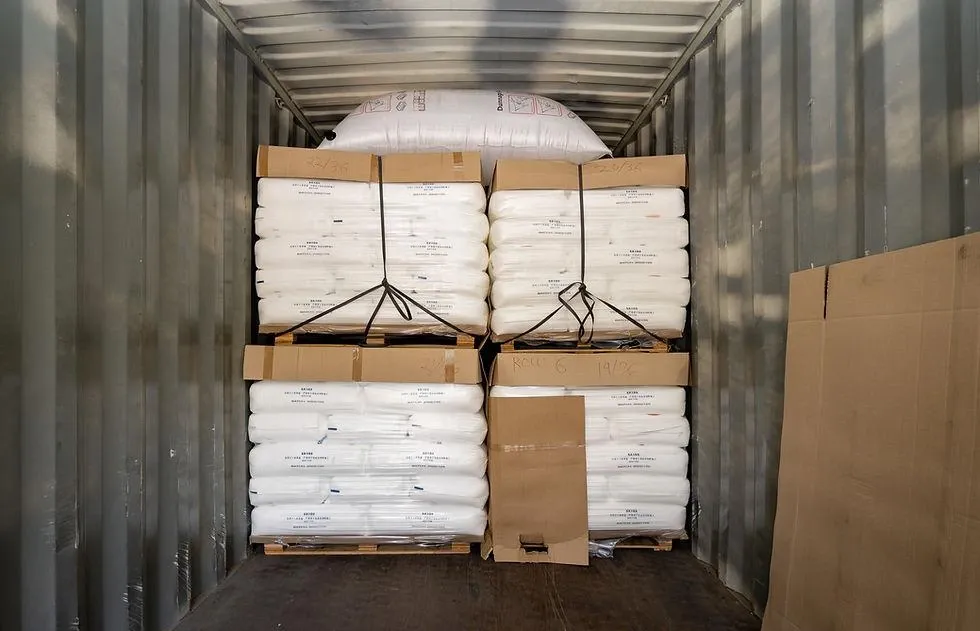
Fills every gap. Any space left between cargo lets it gain speed before it hits something. Air dunnage bags are the quickest way to fill gaps between pallets, drums and crates.
Uses the right bag size and grade for the gap and the cargo weight. Our guides to air dunnage bags and dunnage bag sizes explain how to choose.
Protects the doors. Cargo pressing against the doors is a hazard when the container is opened.
Balancing cost and protection
Export packaging is easy to over-specify and easy to under-specify. A few rules keep the cost in proportion:
Price the failure, not just the packaging. Compare the cost of better packaging with the cost of one damaged or rejected shipment, including replacement goods, freight, delays and the effect on the buyer relationship.
Match the packaging to the weakest leg of the journey. A load that is safe on the ship can still fail on a rough road to the port, or during a transfer between trucks.
Reuse where the packaging comes back. Returnable boxes, bins and layer pads in polypropylene pay for themselves only when they return. For one-way export, choose packaging designed for a single trip.
Standardise sizes. Fewer box and bag sizes make container loading faster and reduce the gaps that need filling.
Marking and documentation
Every export package should be clearly marked with:
consignee and consignor details, or a shipping mark agreed with the buyer;
package number and total count, for example "3 of 12";
gross and net weight;
handling symbols such as "this way up", "fragile" and "keep dry";
country of origin;
the ISPM 15 mark on any solid wood packaging;
UN markings and hazard labels for dangerous goods.
Printed packaging helps here. Logos, handling instructions and batch codes can be printed directly on bags, sheets and boxes, so the markings cannot fall off.
Export packaging checklist
Before every shipment, check that:
Goods are packed for the full journey, not just the first leg.
Packaging is dry, and moisture-sensitive goods are sealed or wrapped.
Any solid wood is ISPM 15 treated and stamped.
Bulk bags are rated for the weight and the product, and labelled.
Dangerous goods are in UN-certified packaging with the correct labels.
Food and pharma packaging meets the buyer's hygiene standard.
The container load is blocked and braced, with every gap filled.
Every package carries the correct marks, numbers and weights.
Packaging details match the commercial invoice and packing list.
Your buyer has confirmed any destination-country requirements.
Shish SmartPack for exporters
Shish manufactures export packaging under the SmartPack range at our 400,000 sq ft facility in Surat, close to India's major ports. Production runs under ISO 9001:2015 and ISO 14001:2015, with BRCGS certification for packaging and AAR certification for dunnage bags. Shish holds AEO T2 status and is a recognised Star Export House.
FIBC bulk bags: 1-loop, 2-loop and 4-loop, conductive (Type C), baffle, ventilated, food-grade and UN-certified variants, in single-trip and multi-trip ratings.
PP corrugated sheets: twin wall (3-ply) and our patented multi wall (5-ply), 2–12 mm, with custom boxes, partitions and layer pads. Our guide to sunpack sheet prices explains how to choose a thickness.
Air dunnage bags (Stuffex): light, medium and heavy duty, plus AAR-certified rail grade, in woven PP or kraft paper.
Rigid PP bubble rolls: 2.5 mm and 4.0 mm, up to 2.5 m wide, for coils, panels and machinery parts.
PP/PE woven fabric: laminated and non-laminated, up to 12 ft (3.66 m) wide.
See the full SmartPack range and our certifications.
Frequently asked questions
What is export packaging?
Export packaging is packaging designed for international shipment. It protects goods through longer journeys and more handling, and meets the packaging, marking and phytosanitary rules of the destination country.
Do plastic pallets and boxes need ISPM 15 treatment?
No. ISPM 15 applies to solid wood packaging material. Packaging made from plastics such as polypropylene does not need heat treatment or the ISPM 15 mark.
How do I stop cargo moving inside a container?
Place heavy goods on the floor, block the load against the walls and doors, and fill every gap. Air dunnage bags are designed to fill the gaps between pallets, crates and drums.
What causes moisture damage in export containers?
Temperature changes during the voyage cause condensation inside the container. Use packaging that does not absorb water, seal sensitive goods, load everything dry, and use desiccants on long voyages.
Which bulk bag is best for export?
Usually a single-trip 5:1 FIBC, because the bag goes to the buyer and you cannot control how it is reused. Food and pharma buyers may also require bags made under a hygiene standard such as BRCGS.
What markings does an export package need?
At minimum: consignee or shipping mark, package number, gross and net weight, handling symbols and country of origin, plus the ISPM 15 mark on solid wood and UN markings for dangerous goods.
Plan your export packaging
Tell us what you export, where it is going, how it travels and how it is packed today. Our team will recommend packaging from the SmartPack range and quote against a specification you can check.
Request an export packaging recommendation
Or speak to the team through the contact page.
