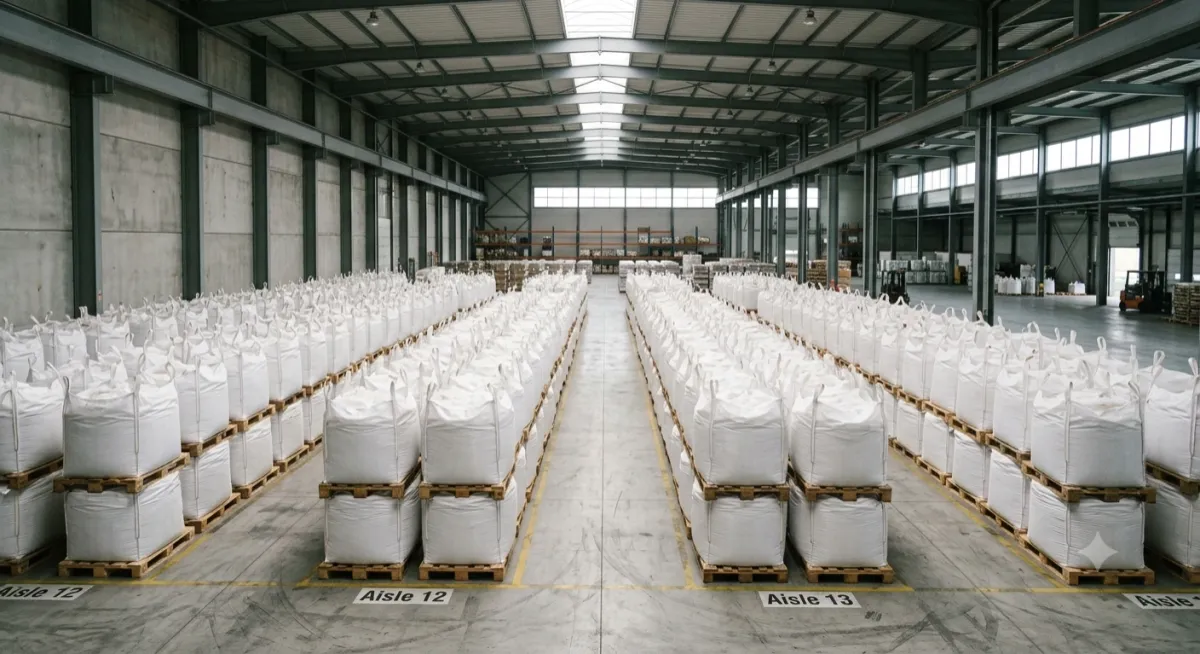
FIBC Bulk Bags: Types, SWL & How to Choose the Right One
FIBC Bulk Bags: Types, Safe Working Load & How to Choose
An FIBC bulk bag is a flexible woven polypropylene container that carries 500 to 2,000 kg of dry, flowable material in a single lift. Choosing the right one comes down to four decisions: how much weight it must carry (SWL), how it will be filled and emptied, whether static electricity is a risk, and whether the bag is used once or many times. Get those four right and almost every other detail follows.
This guide walks through each decision in the order a buyer should make it, with the types, terms and checks that matter before you place an order.
What an FIBC actually is
FIBC stands for Flexible Intermediate Bulk Container. You will also hear jumbo bag, bulk bag, big bag and tonne bag. They all describe the same product: a large bag woven from polypropylene tape, sewn into a cube or cylinder, with lifting loops so a forklift or crane can move it.
"Intermediate" is the useful word. An FIBC sits between small sacks (25 to 50 kg) and rigid bulk containers or silos. One FIBC replaces 20 to 40 small bags, which means fewer handling operations, faster filling, less spillage and far less packaging waste per tonne moved.
Typical contents include:
Construction materials: cement, sand, lime, fly ash
Agriculture: grain, seeds, fertiliser, animal feed
Chemicals and polymers: powders, additives, pigments, resin granules
Food and pharma ingredients: sugar, salt, starch, flour
Minerals: bauxite, iron ore fines, talc, bentonite
Recycling: plastic scrap, rubber chips
Decision 1: Safe Working Load (SWL)
The Safe Working Load is the maximum weight of product the bag is rated to carry in normal use. Common ratings run from 500 kg to 2,000 kg, with 1,000 kg and 1,500 kg the most widely specified.
Two mistakes come up again and again.
Specifying by bag size instead of by weight. A bag's dimensions tell you its volume, not its strength. Two bags of identical size can carry very different loads depending on fabric weight, loop construction and stitching.
Ignoring bulk density. The bag must hold the volume of your product at its rated weight. The calculation is simple:
Required volume (m³) = SWL (kg) ÷ bulk density (kg/m³)
So 1,000 kg of a material with a bulk density of 500 kg/m³ needs about 2 m³ of usable volume. The same 1,000 kg of a material at 1,000 kg/m³ needs only 1 m³. Specify the bag for the lighter, bulkier case and it will be too tall and unstable for the dense one. Specify it for the dense case and it will overflow with the light one.
A worked example. A bag with a 90 × 90 cm base has a footprint of 0.81 m². To hold 1 m³ of product it needs about 1.23 m of fill height, plus allowance for settling and the top closure. Most suppliers will size this for you, but knowing the arithmetic lets you check the quotation.
Decision 2: Body construction
The body is how the fabric is cut and sewn. It affects shape, stability and how efficiently bags fill a truck or container.
Type | How it's made | Best for |
|---|---|---|
U-panel | One long panel forms the base and two sides; two side panels are sewn in | General-purpose use; holds a squarer shape than tubular |
Circular (tubular) | Woven as a seamless tube, base and top sewn on | Fine powders; no vertical side seams for product to sift through |
Baffle (Q-bag) | Internal fabric panels sewn across each corner | Maximum stacking and container fill; stays square when full |
Four-panel | Four separate side panels plus base | Consistent square shape for uniform stacking |
Baffle bags deserve a closer look if you export. A standard bag bulges into a round shape as it fills, wasting space in a container. Internal baffles hold the bag square, so it fills the footprint and stacks more steadily. The extra cost per bag is often recovered in freight, because more product fits in each container.
Decision 3: Filling and discharge
How the product goes in and comes out determines the top and bottom construction.
Filling tops:
Open top: fastest to fill by hand or from a loader. No dust control.
Fill spout: a fabric tube that connects to a filling station. Clean, controlled and dust-reducing.
Duffle (skirt) top: a full-width skirt that ties closed. Easy to fill, and covers bulky product.
Zip or cover top: for tamper resistance and dust control.
Discharge bottoms:
Flat bottom: no discharge; the bag is cut open or tipped. Lowest cost, single-use applications.
Discharge spout: a sewn-in tube that is untied to release product under control. The most common choice.
Conical discharge: a tapered bottom that helps poorly flowing material empty completely.
Full drop bottom: the whole base opens for products that bridge or clump.
Match these to your filling and discharge equipment, not just the product. A spout that is the wrong diameter for your filling head slows every fill on the line.
Decision 4: Lifting loops
Loops carry the full load every time the bag moves, so they are the most safety-critical part of the bag.
Four-loop (corner or cross-corner): the standard. Works with forklifts and most cranes.
One-loop and two-loop: the bag body and loops are formed from a continuous tube of fabric. Common in fertiliser and cement, where many bags are lifted by crane hook in quick succession.
Sleeve loops and tunnel loops: a fabric sleeve across the top takes forklift tines, and spreads the load across more fabric.
Stevedore straps: extra straps for lifting several bags at once, used in some port operations.
Lift a loaded bag only by all its loops, as designed. Lifting a four-loop bag by two loops overloads them, whatever the SWL says.
Decision 5: Static protection (Types A, B, C and D)
Filling and emptying dry powders generates static electricity. In most applications that is harmless. If there is flammable dust, vapour or gas anywhere near the filling or discharge point, it is not. FIBCs are classified by how they deal with static, under the international standard IEC 61340-4-4.
Type | What it is | Where it can be used |
|---|---|---|
Type A | Plain polypropylene, no static protection | Non-flammable products, in areas with no flammable dust or vapour |
Type B | Fabric with low breakdown voltage that prevents the most dangerous discharge type | Flammable dusts are acceptable; flammable vapours or gases are not |
Type C | Conductive fabric with interwoven conductive threads | Flammable environments, only when the bag is earthed during filling and discharge |
Type D | Static-dissipative fabric that does not need earthing | Flammable environments where reliable earthing is impractical |
The rule of thumb: if your site has any flammable atmosphere, this decision belongs to your process safety team, not your purchasing team. A Type C bag that isn't connected to earth is more dangerous than a Type A bag, not less.
Decision 6: Liners and coatings
The woven fabric is strong but not airtight. Liners and coatings add protection.
Uncoated fabric breathes, which suits some agricultural products that need ventilation.
Coated (laminated) fabric resists moisture and stops fine powder sifting through the weave.
LDPE inner liners add a moisture barrier for hygroscopic products.
Aluminium foil liners give a high moisture and oxygen barrier for sensitive food and pharma products.
EVOH multi-layer liners are a strong oxygen barrier for oxidation-sensitive contents.
Conductive liners go with Type C bags.
Single-use or reusable: the safety factor
Every FIBC carries a safety factor, the ratio between the weight the bag must survive in testing and its rated SWL.
5:1 is the standard for single-trip bags. A 1,000 kg SWL bag is tested to withstand 5,000 kg.
6:1 is for multi-trip bags designed to be cleaned, inspected and reused.
The difference matters more than the numbers suggest. Reusing a 5:1 bag is one of the most common causes of FIBC failure. Our companion guide on the 5:1 vs 6:1 safety factor explains when each applies and how reuse should be controlled.
Before you order: a checklist
Product: name, bulk density, particle size, flow behaviour, and whether it is food, pharma or hazardous.
Weight: the SWL you need per bag.
Volume: calculated from SWL and bulk density.
Footprint: base size to suit your pallets, trucks or containers.
Construction: U-panel, circular, four-panel or baffle.
Top and bottom: matched to your filling and discharge equipment.
Loops: matched to your handling equipment.
Static type: A, B, C or D, decided with your safety team.
Liner or coating: if moisture, oxygen or sifting is a concern.
Use: single trip (5:1) or multi-trip (6:1).
Compliance: food contact, BRCGS, UN certification for dangerous goods, or customer-specific standards.
Printing: logo, handling instructions, batch data, export markings.
A supplier who asks you these questions before quoting is a good sign. A price quoted per bag with none of this information is a price for a bag that may not suit your application.
Shish FIBC bags
Shish manufactures FIBCs at our facility in Gujarat, in U-panel, circular, baffle, conductive (Type C), food-clean, UN and ventilated constructions, with one-, two- and four-loop and sleeve lifting options, SWL from 500 to 2,000 kg, and 5:1 or 6:1 safety factors. Production is BRCGS certified; see our full certifications. Specifications are on the FIBC bulk bags page.
Frequently asked questions
What is the difference between an FIBC and a jumbo bag?
None. FIBC is the technical name, and jumbo bag, bulk bag, big bag and tonne bag are trade names for the same product.
What is the most common FIBC size?
There isn't one universal size, because the right volume depends on your product's bulk density. Many bags use a square base of roughly 90 to 95 cm so they sit neatly on standard pallets, with height adjusted to give the required volume.
Can an FIBC be used for food products?
Yes, if it is made under food-safe conditions and, where required, with a suitable liner. Ask for the manufacturer's food safety certification. BRCGS is widely recognised by food and ingredient buyers.
Which static type do I need?
If there is no flammable dust, vapour or gas anywhere near filling or discharge, Type A is normally acceptable. If there is, the choice between Types B, C and D should be made with your process safety team based on the specific hazard.
Can I reuse an FIBC?
Only if it is rated 6:1 for multi-trip use, and only after cleaning, inspection and confirmation that it is undamaged. A 5:1 bag is designed for a single trip.
Are FIBCs waterproof?
Not completely. Coated fabric and inner liners give moisture protection, but sewn seams and closures mean an FIBC should not be stored exposed to rain.
Get the right FIBC specified
Send us your product, required weight and how you fill and empty the bags. Our team will recommend a construction, confirm the volume calculation and quote against a specification you can check.
Request an FIBC specification and quote
Or speak to the team through the contact page.
