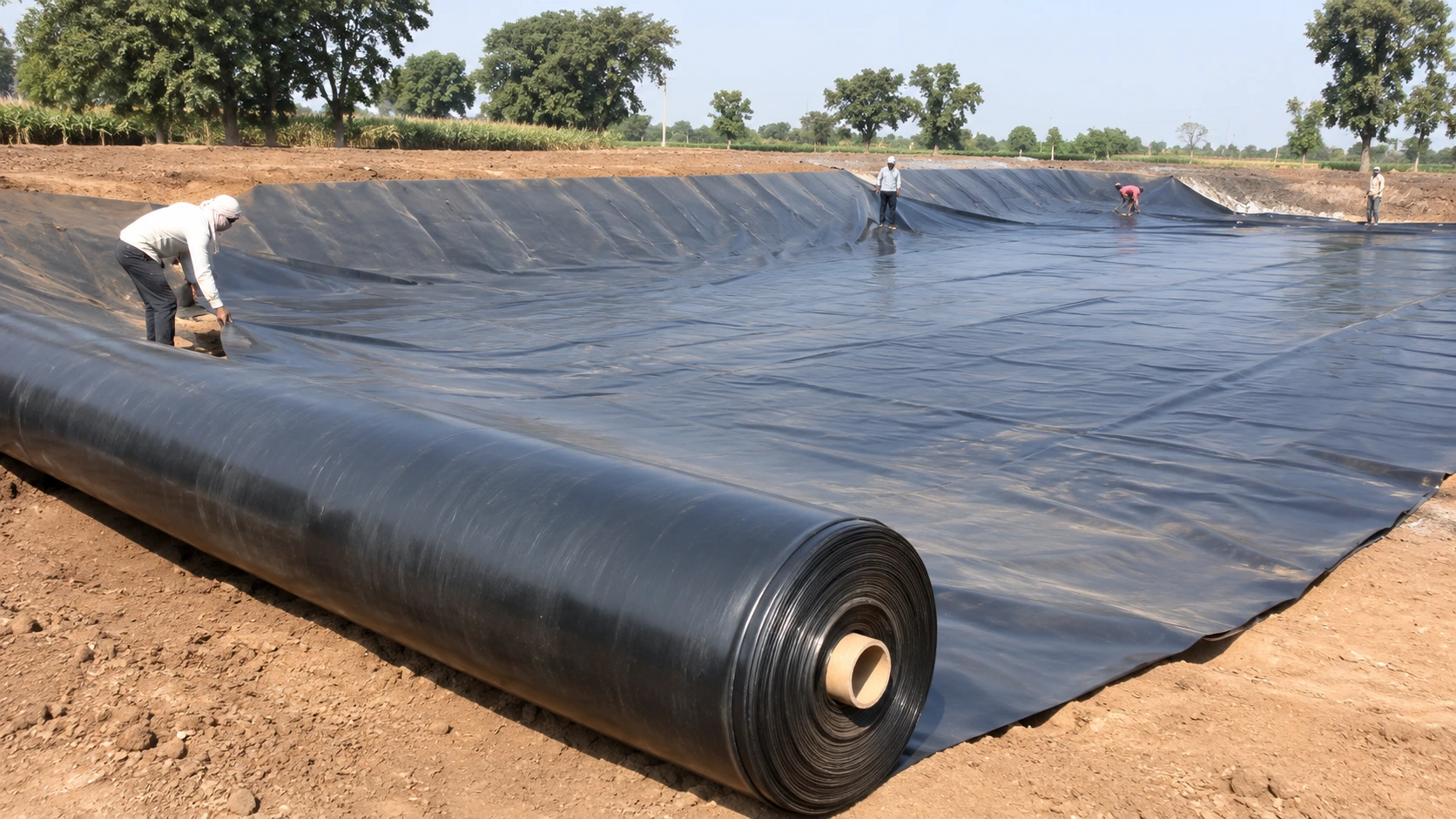
Polythene Sheet Weight per Sq M: Micron to GSM Chart
Polythene Sheet Weight per Square Metre: Micron, Gauge and GSM Chart
If you are pricing a pond liner, a polythene sheet or a geomembrane, you will meet three different numbers: micron, gauge and GSM. They describe the same sheet in different ways, and mixing them up is how buyers end up comparing quotations that are not alike. For a solid polythene sheet, weight per square metre in grams is simply the thickness in microns multiplied by the density of the plastic, so a 500 micron HDPE sheet weighs roughly 475 grams per square metre. For reinforced woven liners, that shortcut no longer works, and GSM is the number to compare.
This guide explains the units, gives a weight chart from 100 to 1,500 microns, shows how to work out the weight of a roll, and explains why laminated woven liners are sold by GSM.
Micron, gauge and GSM: what each one means
Micron (µm) is thickness. One micron is one-thousandth of a millimetre, so 500 microns is 0.5 mm and 1,000 microns is 1 mm.
Gauge is an older thickness unit still widely used in Indian polythene trade. In common Indian usage, 1 micron = 4 gauge, so a 100 gauge sheet is 25 microns and a 1,000 gauge sheet is 250 microns.
GSM (grams per square metre) is weight. It tells you how much material is actually present in each square metre of sheet, regardless of how it is made.
Thickness and weight are linked by density. Two sheets of the same thickness made from different plastics will weigh slightly different amounts, and two liners of the same thickness made in different ways can weigh very different amounts.
The formula for solid polythene sheet
For a solid, single-material sheet:
Weight (g/m²) = Thickness (microns) × Density (g/cm³)
Typical densities are about 0.92 g/cm³ for LDPE (low-density polyethylene, the common soft "polythene" sheet) and about 0.95 g/cm³ for HDPE (high-density polyethylene). Exact density varies by grade, typically 0.91–0.93 for LDPE and 0.94–0.97 for HDPE, so treat the results below as close approximations rather than specifications.
Worked example: a 500 micron HDPE sheet weighs about 500 × 0.95 = 475 g/m², or 0.475 kg per square metre.
Polythene sheet weight chart by micron
Calculated with the formula above, using 0.92 g/cm³ for LDPE and 0.95 g/cm³ for HDPE.
Thickness (micron) | Thickness (mm) | Gauge (approx.) | LDPE weight (g/m²) | HDPE weight (g/m²) |
|---|---|---|---|---|
100 | 0.10 | 400 | 92 | 95 |
150 | 0.15 | 600 | 138 | 143 |
200 | 0.20 | 800 | 184 | 190 |
250 | 0.25 | 1,000 | 230 | 238 |
300 | 0.30 | 1,200 | 276 | 285 |
400 | 0.40 | 1,600 | 368 | 380 |
500 | 0.50 | 2,000 | 460 | 475 |
750 | 0.75 | 3,000 | 690 | 713 |
1,000 | 1.00 | 4,000 | 920 | 950 |
1,500 | 1.50 | 6,000 | 1,380 | 1,425 |
These are theoretical weights for solid sheet. Additives, fillers, recycled content and manufacturing tolerance can move the real figure up or down, which is why it is worth weighing a sample.
How to calculate the weight of a roll
To find the weight of a full roll or panel:
Roll weight (kg) = Width (m) × Length (m) × Weight (g/m²) ÷ 1,000
Example: a 500 micron HDPE sheet, 4 m wide and 50 m long, covers 200 m². At about 475 g/m², the roll weighs roughly 200 × 475 ÷ 1,000 = 95 kg.
This is useful in three ways:
Checking a delivery. If a roll weighs much less than the calculation, the sheet may be thinner, or the material lighter, than quoted.
Planning transport and handling. Large liner panels can weigh several hundred kilograms and need the right equipment on site.
Comparing per-kg and per-square-metre prices. Some suppliers quote by weight and others by area. Converting both to price per square metre makes the quotes comparable.
Converting a per-kg price to a per-square-metre price
Polythene sheet is often quoted per kilogram, while liners and covers are usually budgeted per square metre. To convert:
Price per m² = Price per kg × Weight per m² (in kg)
For a 500 micron HDPE sheet at about 0.475 kg/m², multiply the per-kg rate by 0.475 to get the rate per square metre. For a 250 micron LDPE sheet at about 0.23 kg/m², multiply by 0.23. Run the same conversion on every quotation before comparing them, and always confirm the weight per square metre with the supplier rather than relying on the nominal thickness.
Why micron alone can mislead buyers
A thickness figure tells you how thick the sheet is, not how much material is in it. Two "500 micron" products can differ in weight for several reasons:
Different polymers, such as LDPE against HDPE.
Fillers or recycled content, which change density and strength.
Construction. A sheet with an embossed or textured surface can measure thicker than its actual material content.
Tolerance. A sheet may be thinner in places than its nominal thickness.
That is why our HDPE pond liner price guide recommends comparing quotations on GSM, and asking for it in writing when a supplier quotes only micron.
Reinforced woven liners: why GSM is the standard
Not every liner is a solid sheet. Many agricultural and water-storage liners are reinforced geomembranes: a woven polyolefin fabric laminated on both sides with polyethylene film. The woven core gives tensile strength and puncture resistance, and the film provides the waterproof barrier.
For this construction the micron-to-weight formula does not apply, because the sheet is not one uniform material. Thickness is measured across fabric and film together, and the weight depends on the fabric and film specification. For laminated woven liners, GSM is the reliable number, and it is how the products are graded and sold.
As a rough guide to choosing a weight for a pond, our farm pond lining guide explains where each GSM grade is typically used, and our article what is a geomembrane explains the difference between solid HDPE sheet and reinforced liners.
Choosing the right thickness or weight
Thickness and weight are only part of the decision. Match the liner to:
What it holds. Drinking water, irrigation water, fish ponds and chemical effluent all have different requirements.
The site. Stony or uneven ground needs a heavier, more puncture-resistant liner, or better bed preparation.
Exposure. A liner exposed to sunlight all year needs UV stabilisation and usually a heavier grade.
Service life. Heavier grades generally last longer, which can make them cheaper over the life of the pond.
Certification. For geo liners in India, look for conformity with BIS IS 15351:2015; for drinking water contact, look for NSF 61.
Shish Liner geomembranes
Shish Liner, part of Shish SmartBuild, is a reinforced geomembrane: a woven polyolefin fabric laminated with polyethylene film, made at our Surat facility. It is available in 250, 500, 750 and 1,000 GSM, with thickness from 0.5 mm to 1.5 mm depending on the grade, in standard black, UV stabilised for long outdoor exposure in Indian conditions.
Shish Liner is certified to BIS IS 15351:2015 for geo liners and NSF 61 for safe use in drinking water systems. Factory-fabricated panels are available up to 8 metres wide in custom lengths, and service life ranges from 8 to 25 years depending on the grade and exposure. See the full specifications on the pond liner page and our certifications.
Frequently asked questions
What is the weight of a 500 micron polythene sheet per square metre?
About 460 g/m² for LDPE and about 475 g/m² for HDPE, calculated as thickness in microns multiplied by density. Real weight varies slightly with grade, additives and tolerance.
How do I convert micron to GSM?
For a solid polythene sheet, multiply the thickness in microns by the density in g/cm³: roughly 0.92 for LDPE and 0.95 for HDPE. For laminated woven liners this conversion does not apply; use the GSM stated by the manufacturer.
How many gauge is 1 micron?
In common Indian polythene trade usage, 1 micron equals 4 gauge. So 250 microns is about 1,000 gauge.
Is 500 micron the same as 500 GSM?
No. Micron measures thickness and GSM measures weight per square metre. A 500 micron solid HDPE sheet weighs roughly 475 g/m², and a 500 GSM laminated woven liner may have a different thickness depending on its construction.
How do I calculate the weight of a liner roll?
Multiply width (m) by length (m) by weight (g/m²), then divide by 1,000 to get kilograms. A 4 m by 50 m roll at 475 g/m² weighs about 95 kg.
Which thickness is best for a farm pond?
It depends on the soil, exposure and how long the pond must last. Many farm ponds use mid-weight liners such as 500 GSM; stony sites, aquaculture and long-life projects usually justify heavier grades.
Get the right liner specified
Tell us what the liner will hold, the size of the area and the site conditions. Our team will recommend a GSM grade, explain the reasoning, and quote against a specification you can check.
Request a pond liner recommendation and quote
Or speak to the team through the contact page.
