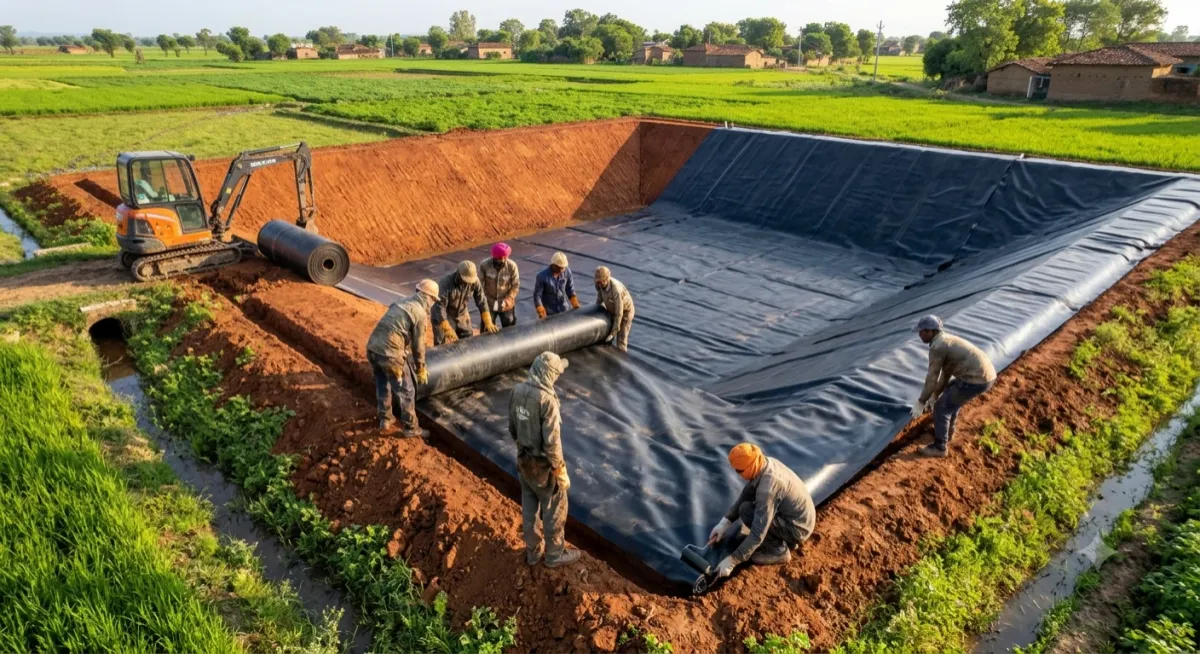
Farm Pond Lining Guide: Liner Size, Cost & Installation
Farm Pond Lining: Sizing, Cost and Installation Guide
A farm pond only pays for itself if it holds water through the dry months. In most Indian soils an unlined pond loses a large share of what it collects to seepage long before the crop needs it. Lining the pond is what turns a seasonal pit into reliable storage, and the three decisions that decide whether a lining succeeds are the right liner weight, the right sheet size, and careful installation. Get those right and a lined farm pond can serve for many seasons. Get them wrong and the liner fails at the first sharp stone or the first hot summer.
This guide walks through sizing a farm pond, choosing a lining material, calculating how much liner you need, budgeting, and installing it step by step.
Why farm ponds need a lining
Rainwater harvested in a farm pond is meant to carry a crop through a dry spell or a second season. In sandy, gravelly, red and laterite soils, water drains through the pond bed and walls quickly. Even in heavier soils, cracks open as the pond dries and the next fill drains away through them.
A geomembrane liner places an impermeable barrier between the water and the soil. The practical benefits are:
Water stays for the season. Seepage losses drop sharply, so the stored volume is still there when you need to irrigate.
Smaller pond, same water. Because less is lost, a lined pond of a given size delivers more usable water than an unlined one of the same size.
Cleaner water. A lined pond is less muddy, which helps drip and sprinkler systems that clog easily.
Fish farming becomes possible. Many farmers combine storage with aquaculture once the water level is stable.
Step 1: Decide the size and shape
Start from the water you need, not from the land you have. Estimate how many irrigations you want the pond to supply, the area and crop each covers, and the dry period it must bridge. Your local agriculture or horticulture office can help with crop water requirements for your district.
Then fix three dimensions:
Depth. Deeper ponds lose less to evaporation per litre stored, because less surface is exposed to sun and wind. Many farm ponds are dug about 3 metres deep, limited by soil, water table and the equipment available.
Side slope. The sides must be stable when the pond is full and when it is empty. Slopes are written as horizontal to vertical, such as 1.5:1 or 2:1. Loose or sandy soils need gentler slopes.
Shape. Square and rectangular ponds are the simplest to line, because the liner can be fabricated or joined in straight panels. Irregular shapes need more cutting, more joints and more wastage.
Step 2: Choose the lining material
Several materials are used to line farm ponds in India:
Material | Seepage control | Notes |
|---|---|---|
Compacted clay or soil | Partial | Cheapest where good clay is nearby; cracks when dry |
Cement or brick lining | Good when intact | High labour and material cost; cracks with soil movement |
Plain polyethylene film | Good when new | Thin and easily punctured; short life in sunlight |
Geomembrane liner | Excellent | Engineered for UV, puncture and long outdoor service |
For most farmers, a geomembrane liner is the practical choice. It installs in days, follows the shape of the pond, and is built for continuous outdoor exposure. If you are comparing geomembrane products, our guide to HDPE pond liner price in India explains why two liners sold under the same name can be very different products.
Which weight (GSM) to choose
Pond liners are sold by weight per square metre (GSM). Heavier material is thicker, more puncture-resistant and longer-lasting. As a general guide:
250 GSM: lighter-duty and seasonal storage, on well-prepared, stone-free beds.
500 GSM: the common choice for farm ponds and irrigation storage.
750 GSM: aquaculture, larger ponds, and rougher sites.
1000 GSM: heavy-duty and industrial use, or where the longest life is the priority.
If your soil is stony or the bed cannot be prepared perfectly smooth, move up a grade rather than gamble on the lighter one.
Step 3: Calculate how much liner you need
The liner must cover the floor, run up every sloped side, and continue into an anchor trench at the top. A simple way to calculate it for a square or rectangular pond:
Sloped side length = depth × √(1 + slope²), where slope is the horizontal figure in the ratio (1.5 for a 1.5:1 slope).
Liner length = bottom length + 2 × sloped side length + 2 × anchor allowance.
Liner width = bottom width + 2 × sloped side length + 2 × anchor allowance.
Area = liner length × liner width, then add 2–5% slack so the liner can settle under water load without being stretched.
Worked example
A square pond with a 20 m × 20 m floor, 3 m deep, with 1.5:1 side slopes, and 0.75 m allowed at each edge for anchoring:
Sloped side length = 3 × √(1 + 2.25) = 5.41 m
Liner length and width = 20 + (2 × 5.41) + (2 × 0.75) = 32.3 m
Area = 32.3 × 32.3 = about 1,045 sq m
With 5% slack = about 1,100 sq m
The top of this pond measures 29 m × 29 m and it holds roughly 1,800 cubic metres, about 18 lakh litres, when full.
Notice that the liner is more than two and a half times the area of the pond floor (400 sq m). Estimating from the floor area alone is the most common reason farmers run short on site.
Step 4: Budget for the liner
Using the indicative market rates from our pond liner price guide, 500 GSM liner is commonly listed by Indian suppliers at around ₹90 to ₹120 per square metre. For the 1,100 sq m example above, that puts the liner material at roughly ₹1 lakh to ₹1.3 lakh.
These are market rates observed across published listings, not a Shish Industries price list, and they cover material only. Add excavation, bed preparation, any panel joining, the anchor trench, transport and labour. Several state governments run farm pond schemes for farmers. Check current eligibility and any approved specifications with your district agriculture office before you buy, because some schemes require certified material.
Step 5: Prepare the site
Most liner failures start under the liner, not on top of it. Before the liner arrives:
Grade and compact the floor and walls to a smooth, firm surface.
Remove every stone, root and sharp object. Walk the whole surface; one sharp stone under water pressure can puncture any liner.
Treat for termites and weeds if they are common in your area, since roots can push through from below.
Dig the anchor trench around the top edge, typically about 300 mm deep, set back from the edge of the slope.
Let water drain away from the pond. Shape the ground so rainwater does not run under the liner from outside.
Step 6: Lay, join and anchor the liner
Unroll carefully. Place the liner over the pond, aligned so it reaches the anchor trench on every side. Never drag it over the ground; lift and carry.
Join panels if needed. If your pond is wider than one sheet, panels are overlapped by 100–150 mm and joined by hot wedge welding or extrusion welding for a watertight seam. Factory-fabricated panels reduce the amount of joining done on site.
Leave slack. Allow 2–5% extra so the liner settles into the corners as the pond fills instead of being pulled tight.
Anchor the edges. Lay the liner edges into the anchor trench, then backfill and compact firmly.
Fill steadily. Begin filling while checking the liner settles evenly. Keep people off the liner, or use soft footwear when someone must walk on it.
Step 7: Look after the lined pond
Keep cattle and sharp tools away from the liner, and fence the pond for safety.
Use a fixed pipe or a protected outlet for pumping, so the suction hose does not rub the liner.
Inspect the edges and the waterline after heavy rain or wind.
Repair small damage promptly before it spreads.
Remove silt periodically with care, without scraping the liner surface.
Shish Liner for farm ponds
Shish Liner is a woven polyolefin geomembrane laminated with polyethylene films, made at our Surat facility in 250, 500, 750 and 1000 GSM. It is certified to BIS IS 15351:2015 for geo liners and NSF 61 for safe use in drinking water systems, and is UV stabilised for long outdoor exposure in Indian conditions. Factory-fabricated panels are available up to 8 metres wide in custom lengths, and service life ranges from 8 to 25 years depending on the grade and exposure. See the full specifications on the pond liner page and our certifications.
Frequently asked questions
Which liner is best for a farm pond in India?
A UV-stabilised geomembrane liner certified to IS 15351 is the most practical choice for most farm ponds. 500 GSM suits typical farm storage; choose 750 GSM for aquaculture, larger ponds or stony sites.
How much liner do I need for my farm pond?
Add the floor dimensions, twice the sloped side length, and twice the anchor allowance for each direction, multiply length by width, and add 2–5% slack. For a 20 m × 20 m floor, 3 m deep with 1.5:1 slopes, that comes to about 1,100 sq m.
How long does a farm pond liner last?
It depends on the grade, sunlight exposure and how well the site was prepared. Shish Liner has a service life of 8 to 25 years depending on GSM and exposure conditions.
Can I keep fish in a lined farm pond?
Yes. A lined pond keeps a stable water level, which suits fish farming. Heavier grades such as 750 GSM are commonly used for aquaculture.
Do I need to weld the liner?
Only if the pond is wider than a single sheet or panel. Joints are overlapped 100–150 mm and hot wedge or extrusion welded. Factory-fabricated panels reduce site joining.
Is a liner covered under farm pond subsidy schemes?
Many states run farm pond schemes, and the rules differ by state and by year. Ask your district agriculture office what is currently covered and whether a certified liner is required.
Get the right liner for your pond
Send us your pond dimensions, depth and side slope. Our team will calculate the liner area, recommend a grade for your soil and use, and quote against a specification you can check.
Request a farm pond liner quotation
Or speak to the team through the contact page.
