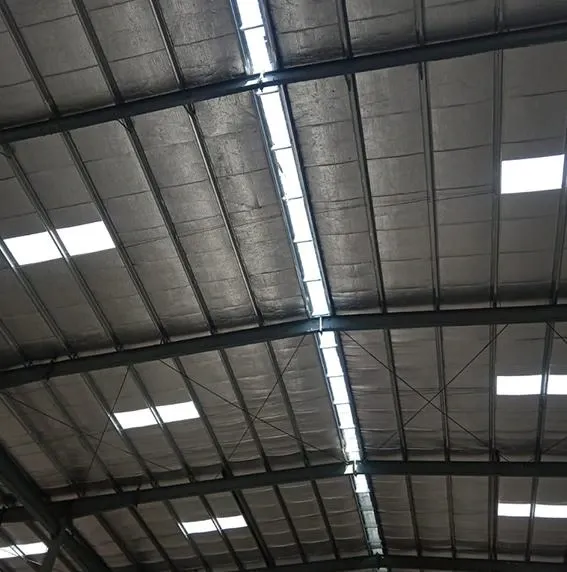
Roof Heat Insulation Sheet Price in India: Cost Guide
Roof Heat Insulation Sheet Price in India: Types and Cost per Sq Ft
A metal roof in India can turn a factory, warehouse or poultry shed into an oven by early afternoon. Roof heat insulation sheets are the most common fix, but "insulation sheet" covers several very different products, and their prices are quoted in different units. The price you pay depends first on the type of insulation, then on its thickness, facing and the area you need to cover. A cheap sheet of the wrong type can cost more in the end than a dearer sheet of the right one.
This guide explains the main types of roof heat insulation sheet sold in India, how they are priced, current market rates, and how to choose for your building.
Why metal roofs get so hot
Sunlight heats a metal roof sheet very quickly. The hot sheet then passes that heat into the building in two ways:
Radiant heat: the underside of the hot sheet radiates heat downwards onto people, stock and machinery, like standing near a heater.
Conducted heat: heat travels through anything touching the sheet, and warms the air directly under it.
Under a bare metal roof in an Indian summer, radiant heat is usually the larger share of the heat you feel. That is why reflective insulation, which stops radiant heat, works so well under metal sheets. It is also why the air gap around a reflective layer matters so much, as explained below.
The main types of roof heat insulation sheet
Reflective bubble insulation
A layer of air bubbles laminated between reflective foil or metallised film. The foil reflects radiant heat, and the trapped air slows conducted heat. It is light, clean to handle and quick to fix under purlins, which makes it the most common choice for sheds, warehouses and PEB buildings.
Bubble insulation comes in soft and rigid versions. A rigid polypropylene bubble core resists crushing and tearing during installation and over the life of the roof.
Radiant barrier sheet
A thin woven core laminated with metallised film on both sides. It has little bulk of its own; it works by reflecting radiant heat across an air gap. It is the lightest and usually the most economical option per square foot, and can double as a moisture barrier under the roof.
Foam sheets (EPE and XLPE)
Closed-cell polyethylene foam, often foil-faced. Foam adds conducted-heat resistance as well as reflection, and is common in residential and commercial roofs.
PUF and PIR sandwich panels
Rigid foam bonded between two metal sheets, sold as complete roof or wall panels. They insulate very well and replace the roof sheet itself, but they cost far more per square foot and are normally specified for cold rooms, clean rooms and new buildings rather than retrofits.
Glass wool and rock wool
Mineral fibre blankets, usually with a foil facing. Good for heat and sound, but they need careful handling because of the fibres, and they lose performance if they get wet.
For a detailed side-by-side comparison of the reflective options, read our guide to radiant barrier vs bubble insulation vs PUF.
How insulation sheets are priced
Suppliers quote in different units, which makes quotations hard to compare:
Per square foot or per square metre, the most common for sheets and rolls.
Per roll, for standard rolls. Divide by the roll area to compare.
Per panel or per running metre, for sandwich panels.
Always convert everything to price per square foot (or per square metre) before comparing. One square metre is about 10.76 square feet.
Market rates in October 2026
From published listings by Indian suppliers and marketplaces checked on 30 October 2026, basic reflective and bubble insulation sheets were commonly listed at roughly ₹6 to ₹9 per square foot, or about ₹50 to ₹90 per square metre. Heavier and specialist products cost more, and insulated metal panels were listed at several hundred rupees per square metre.
These figures are market rates for comparison only. They are not a Shish Industries price list. Prices vary with thickness, facing (aluminium foil or metallised film), rigidity, fire rating, roll size, quantity, region and raw material prices. For pricing on your own roof, request a quotation.
What changes the price
Type of insulation. Radiant barrier sheets are usually the lowest cost per square foot; bubble and foam sheets sit in the middle; sandwich panels are the highest.
Thickness. Thicker bubble and foam sheets cost more and add conducted-heat resistance.
Rigid or soft core. A rigid core costs more but resists crushing and tearing, which matters on large industrial roofs.
Facing. Pure aluminium foil and metallised polyester film are priced differently. Ask which one is in the quotation.
Fire rating. Products tested to a fire standard, such as ASTM E84, can cost more. Many industrial buyers and insurers require it.
Roll width and length. Wider rolls mean fewer overlaps and less tape on large roofs.
Area and quantity. Larger projects are usually priced lower per square foot.
Working out the cost for your roof
Measure the roof area in square feet: length × width of each roof slope, added together.
Add 10% for overlaps and cutting. Most products are overlapped by 50–100 mm at the joints.
Multiply by the price per square foot of the product you are comparing.
Add accessories and labour: reflective foil tape for the joints, fasteners, and any support wire or battens.
As an illustration only: a 10,000 sq ft shed roof plus 10% for overlaps needs about 11,000 sq ft of sheet. At an illustrative ₹8 per sq ft, that is about ₹88,000 for the material before tape, fasteners and labour.
The air gap rule
Reflective insulation only reflects radiant heat if it faces an air gap. If the shiny surface is pressed flat against the hot roof sheet, heat simply conducts through it and much of the benefit is lost.
For retrofits inside an existing shed, fix the sheet on light framing, battens or tension wire so that it sits 20–50 mm below the roof sheet.
For new roofs, the sheet is laid over the purlins before the roof sheets go on, with the reflective side facing the air space.
Tape every joint with reflective foil tape so that the layer is continuous.
Getting the air gap right often matters more than the choice of product.
Choosing by building type
Building | Usual choice |
|---|---|
PEB factories and large warehouses | Rigid bubble insulation or radiant barrier, with roof ventilation |
Poultry and dairy sheds | Rigid bubble insulation, for durability and moisture control |
Existing sheds (retrofit) | Radiant barrier or bubble insulation on battens or wire, with an air gap |
Cold rooms and clean rooms | PUF or PIR sandwich panels |
Residential metal roofs | Bubble or foil-faced foam sheet |
Insulation works best together with ventilation. Hot air still collects at the top of a tall shed, so ridge vents or turbine ventilators remove the heat that does get in. Our guide to roof ventilation for PEB and factory sheds explains how to size them.
What to check before you order
Type of insulation, and whether the core is rigid or soft.
Thickness in millimetres.
Facing: aluminium foil or metallised film, on one side or both.
Reflectivity, and the test standard it was measured to.
Fire rating, if your building or insurer needs it.
Roll width and length, so you can work out the overlaps.
Price basis: per sq ft, per sq m or per roll, with GST and delivery stated.
Accessories: whether foil tape and fasteners are included.
Shish roof insulation
Shish makes two reflective insulation products under the Carmika brand at our Surat facility:
Carmika Premium is a heavy-duty rigid bubble insulation: a rigid polypropylene air-bubble core laminated between reflective aluminium or metallised foil. It is 4 mm thick, with ≥97% reflectivity (ASTM C1371), a thermal resistance of about R2.9 (ASTM C518, air-space dependent), water vapour transmission below 0.01 perms, and tear strength of 20–30 N warp and 18–28 N weft (ASTM D2261). Rolls are 1.2 m wide as standard, customisable up to 2.5 m, in 30 m and 40 m lengths. A Class 1 / Class A fire rating (ASTM E84) is optional. See the Carmika Premium page.
Carmika Eco is a radiant barrier: a woven polyolefin core laminated with metallised PET film on both sides, about 105 GSM, with ≥95% reflectivity (ASTM C1371). It comes in a solid version that is a complete vapour barrier and a breathable, perforated version for ventilated roofs, in 4 ft and 8 ft wide rolls of 250 ft. See the radiant barrier page.
Both are fibre-free and safe to handle. See our certifications for the standards our roofing products are tested to.
Frequently asked questions
What is the price of roof heat insulation sheet in India?
From supplier and marketplace listings checked on 30 October 2026, basic reflective and bubble insulation sheets were commonly listed at roughly ₹6 to ₹9 per square foot (about ₹50 to ₹90 per square metre). Sandwich panels and specialist products cost more. These are market rates, not a Shish price list.
Which is the best insulation sheet for a metal roof?
For most industrial sheds and warehouses, reflective insulation such as rigid bubble insulation or a radiant barrier gives the best value, because most of the heat under a metal roof is radiant. Cold rooms and clean rooms usually need PUF or PIR panels.
Does roof insulation work without an air gap?
Reflective insulation needs an air gap on its reflective side to work properly. Fixed flat against the hot roof sheet, much of its radiant benefit is lost.
How much roof insulation do I need?
Measure the roof area, then add about 10% for overlaps and cutting.
Can insulation be added to an existing shed?
Yes. Reflective sheets can be fixed inside an existing roof on battens, light framing or tension wire, leaving a 20–50 mm air gap below the roof sheet.
Is bubble insulation the same as a radiant barrier?
No. A radiant barrier is a thin reflective sheet that works by reflection across an air gap. Bubble insulation adds a layer of trapped air between reflective faces, so it also slows conducted heat.
Get a roof insulation quotation
Tell us your roof area, the type of building, whether the roof is new or existing, and the roof sheet type. Our team will recommend the right Carmika product and quote against a specification you can check.
Request a roof insulation quotation
Or speak to the team through the contact page.
