Radiant Barrier vs Bubble Insulation vs PUF: Which to Use
Radiant Barrier vs Bubble Insulation vs PUF for Factory Roofs
If you are insulating a factory or warehouse roof in India, three options come up again and again: a radiant barrier foil, bubble insulation, and PUF (polyurethane foam) panels. They are not three versions of the same thing. A radiant barrier and bubble insulation mainly stop heat by reflecting it, while PUF stops heat by resisting its flow through a thick foam core. Which one is right depends on whether you are fighting the sun on a metal roof or holding a controlled temperature inside. Pick the wrong type and you pay for performance you don't need, or miss the one you do.
This guide explains how each works, where each fits, what to compare on a data sheet, and how to install reflective insulation so it actually performs.
How heat gets into a factory roof
Heat moves in three ways, and roof insulation products target them differently.
Radiation. Heat travels as infrared energy from a hot surface to a cooler one. A sun-baked metal roof sheet radiates heat down into the building. On a typical Indian metal roof, this is the largest source of unwanted heat.
Conduction. Heat moves through a solid material, such as from the hot roof sheet into anything touching it.
Convection. Heat is carried by moving air, such as hot air collecting under the roof.
A product that is excellent against one of these can be weak against another. That is the key to choosing.
Option 1: Radiant barrier
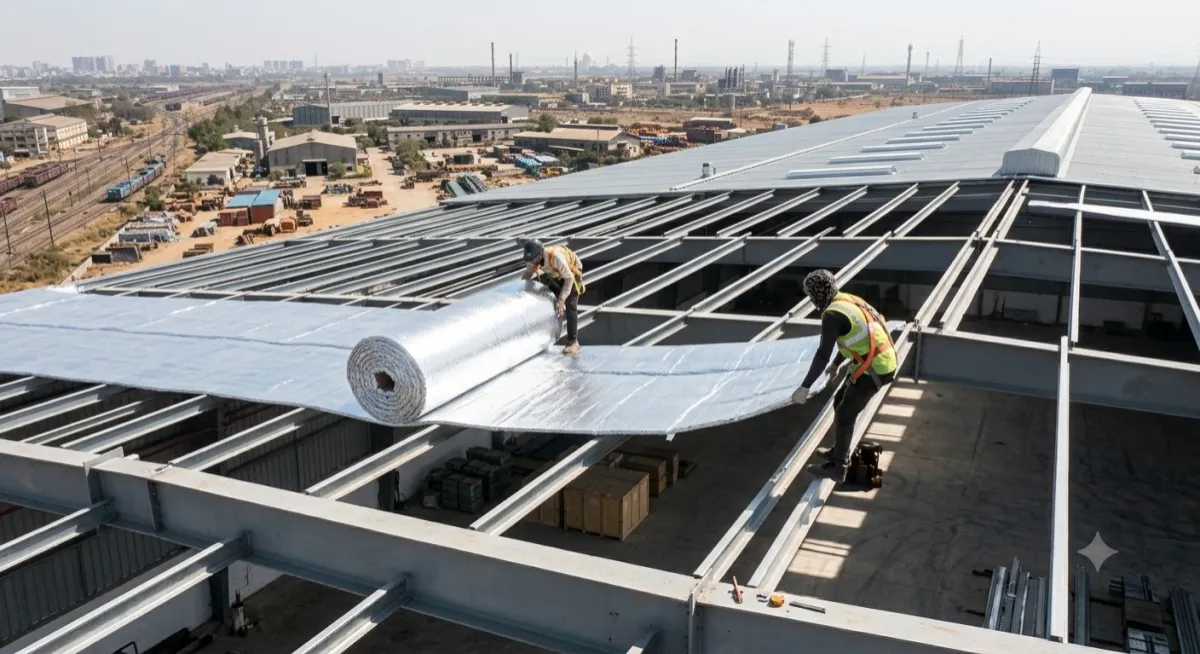
A radiant barrier is a thin sheet with a highly reflective surface, usually metallised polyester (MPET) or aluminium foil, often reinforced with a woven scrim. It works by reflecting radiant heat instead of absorbing it, and by having a low emissivity, so it gives off very little heat itself.
Where it fits:
Under metal roof sheets and roof decking
Behind wall cladding as a radiant shield
In retrofits, fixed inside existing sheds or attics
Strengths: light, thin, quick to install, and it targets the biggest heat source on a metal roof. It can also act as a vapour barrier (solid type) or a breathable membrane (perforated type), depending on the climate and building.
Limitation: it needs an air gap next to its reflective face to work. A foil pressed tight against a hot sheet conducts heat rather than reflecting it. It adds little resistance to conducted heat.
Option 2: Bubble insulation
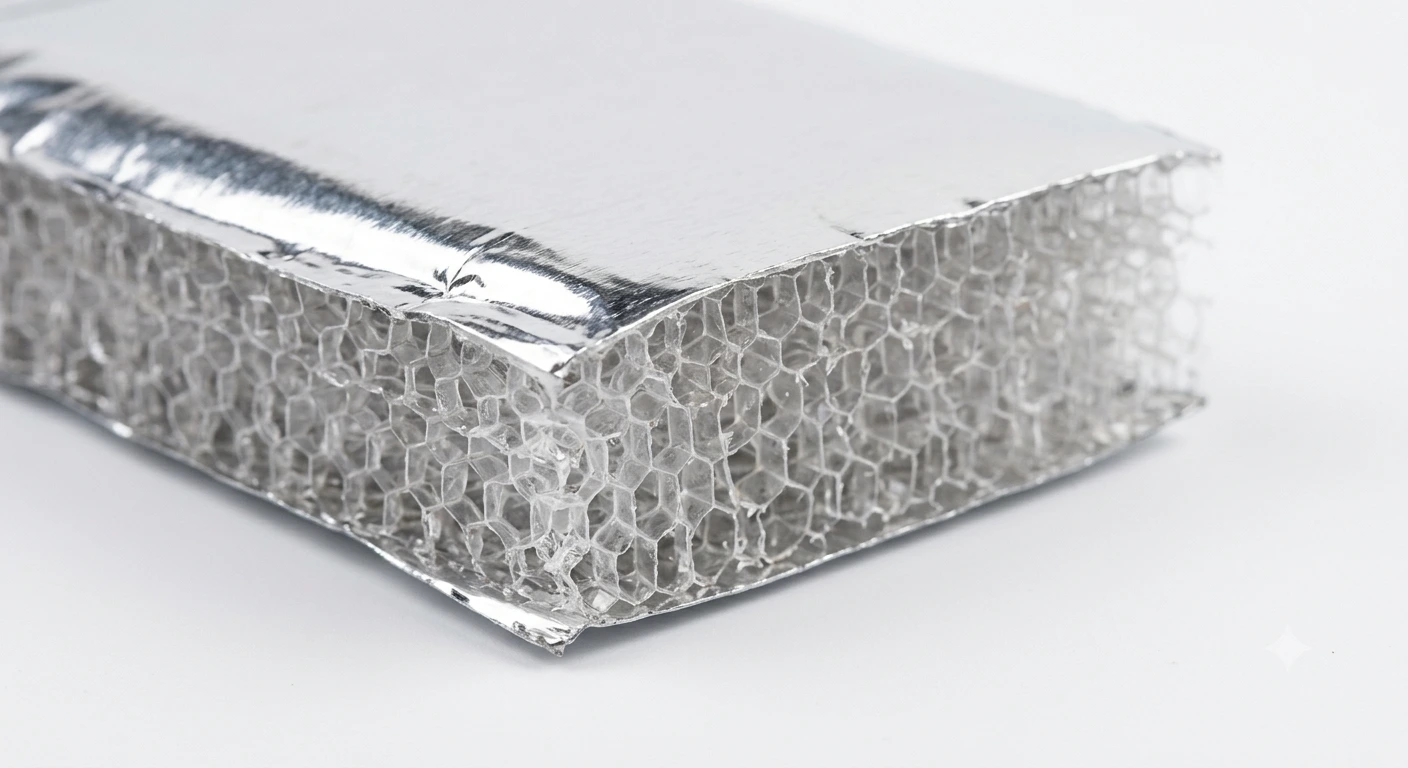
Bubble insulation combines a layer of air bubbles with reflective foil on one or both sides. The foil reflects radiant heat in the same way as a radiant barrier, and the bubble layer adds some resistance to conducted heat and gives the sheet body and strength.
Bubble insulation comes in different grades. Soft bubble sheets are light and flexible; rigid bubble insulation, with a polypropylene bubble core, resists crushing, puncturing and tearing during installation and over the life of the roof, which matters on large industrial projects.
Where it fits:
Under new metal roofing on PEBs, warehouses and sheds
Retrofits inside existing metal roofs
Wall insulation in metal buildings
Poultry and livestock sheds, where condensation control matters
Strengths: reflective performance plus a moisture and vapour barrier, in a single roll that is easy to handle and install. It is fibre-free and dust-free, so it does not irritate installers' skin or lungs.
Limitation: like a radiant barrier, its reflective performance depends on an air gap next to the foil face.
Option 3: PUF panels
PUF (polyurethane foam) panels are sandwich panels: a rigid foam core, typically between two metal skins. Instead of reflecting heat, the foam core resists the flow of conducted heat, and its performance rises with thickness.
Where it fits:
Cold rooms, cold storage and temperature-controlled warehouses
Clean rooms and controlled process areas
Buildings designed from the start with insulated panels as the roof or wall
Strengths: high insulation for holding a set temperature inside, and the panel can be the roof or wall itself.
Limitations: it is a structural building element rather than an added layer, so it is usually planned at design stage, and it is generally a heavier and more involved installation than a roll product. Fire performance depends on the foam grade specified, so check the fire rating for your project.
Side-by-side comparison
Radiant barrier | Bubble insulation | PUF panel | |
|---|---|---|---|
Main mechanism | Reflects radiant heat | Reflects radiant heat + some resistance to conduction | Resists conducted heat |
Form | Thin reflective sheet | Reflective bubble sheet in rolls | Rigid sandwich panel |
Best for | Cutting solar heat from metal roofs | Metal roof and wall insulation, new or retrofit | Cold storage and temperature-controlled buildings |
Needs an air gap? | Yes | Yes, for reflective performance | No |
Vapour control | Solid type = vapour barrier; perforated type = breathable | Vapour barrier | Depends on panel design |
Retrofit | Easy | Easy | Usually means replacing the roof or wall |
Weight | Very light | Light | Heavier |
A simple rule: if the problem is a hot metal roof in the sun, reflective insulation (radiant barrier or bubble) is designed for exactly that. If you need to hold a low or fixed temperature inside, PUF panels are designed for that.
What to compare on a data sheet
When you compare products, look for tested figures, and check which standard they come from:
Reflectivity, which should be stated as a percentage and, ideally, with the test standard (for example ASTM C1371)
Thermal resistance (R-value), with the test standard (for example ASTM C518) and, for reflective products, the air-space assumption behind it
Water vapour transmission in perms, if you need a vapour barrier
Fire rating, for example ASTM E84 Class A
Tear and puncture strength, which matters on large roofs and windy sites
Thickness, roll width and roll length, because wider rolls mean fewer seams and faster installation
Be cautious of R-values quoted for reflective products with no air-space condition. Their performance depends on the air gap, so a number without that context is hard to compare.
Installing reflective insulation correctly
Most poor results from reflective insulation come from installation, not the product.
Keep an air gap. The foil face must face an air space. On retrofits, an air gap of around 20 to 50 mm between the insulation and the roof sheet helps radiant performance.
Overlap and tape every seam. Overlap adjacent sheets by about 75 to 100 mm and seal joints with reflective foil tape, so the vapour barrier is continuous.
Fix at regular intervals. Fasten to purlins or framing members, roughly every 400 to 600 mm, with heavy-duty staples or mechanical fasteners.
Don't stretch or crush it. Lay it flat without tension, and don't compress rigid sheets during fixing.
Protect the foil. Handle carefully so the reflective surface is not scratched or dulled.
Install in dry weather for the best tape adhesion.
Insulation works best alongside ventilation. Our guide to roof ventilation for PEB and factory sheds explains how a ridge vent and a ventilated air gap remove the heat that does get in.
Shish roof insulation options
SmartBuild Radiant Barriers reflect up to 97% of radiant heat and come in solid (vapour barrier, 0 perms) and breathable (perforated) types, with MPET or pure aluminium foil faces, one- or two-side reflective, in Eco (~95 GSM), Standard (~105 GSM) and Premium (~120–130 GSM) grades. All are rated ASTM E84 Class A, VOC-free, and supplied in widths up to 8 ft and lengths of 100 to 500 ft. See the radiant barrier page.
Carmika Premium is a rigid bubble insulation with a polypropylene bubble core laminated between pure aluminium foil faces. It is 4 mm thick, with reflectivity of ≥97% (ASTM C1371), thermal resistance of ~R2.9 (ASTM C518, air-space dependent), water vapour transmission below 0.01 perms, and tear strength tested to ASTM D2261. Rolls are 1.2 m wide as standard (up to 2.5 m on request) in 30 or 40 m lengths. See the Carmika Premium page.
Shish is ISO 9001:2015 and ISO 14001:2015 certified; see our certifications.
Frequently asked questions
Which is better, radiant barrier or bubble insulation?
Both reflect radiant heat. Bubble insulation adds a bubble layer that gives some resistance to conducted heat, more body and a vapour barrier in one product. A radiant barrier is thinner and lighter. For heavy-duty industrial roofs, rigid bubble insulation is often preferred for its strength during installation.
Is PUF better than bubble insulation for a factory roof?
It depends on the goal. PUF panels are designed to hold a controlled temperature, such as in cold storage. For reducing solar heat from a metal roof in a general factory or warehouse, reflective insulation is designed for exactly that job and is easier to retrofit.
Does reflective insulation work without an air gap?
Not well. A reflective surface needs an air space next to it to reflect radiant heat. Pressed directly against a hot sheet, it conducts heat instead.
Can I add insulation to an existing shed roof?
Yes. Radiant barriers and bubble insulation can be fixed inside an existing roof using battens, tension wires or steel channels, leaving an air gap between the insulation and the roof sheet.
What does ASTM E84 Class A mean?
It is the highest classification under the ASTM E84 surface-burning test, which measures how quickly flame spreads across a material and how much smoke it produces.
Does roof insulation stop condensation?
A continuous vapour barrier, with all seams taped, helps prevent warm humid air reaching the cold underside of the roof sheet, which is what causes condensation drip. Ventilation also helps by removing humid air.
Get your roof insulation specified
Tell us your building size, roof type, whether it is a new build or a retrofit, and how the building is used. Our team will recommend the right insulation and ventilation combination and quote for your project.
Request a roof insulation recommendation and quote
Or speak to the team through the contact page.
