Food-Grade FIBC Bags: BRCGS, Liners & What to Check
Food-Grade FIBC Bags: BRCGS, Liners & What to Check
A food-grade FIBC is a bulk bag made, handled and packed so that it is safe to be in direct contact with food or pharmaceutical ingredients. What makes a bag food-grade is not one feature but a chain: clean raw material, a controlled factory, the right liner, and a certified hygiene system behind all of it. BRCGS certification is how a buyer checks that the chain is real. A bag that looks clean is not the same thing as a bag made under a food-safety system.
This guide explains what "food-grade" should mean when you specify an FIBC for sugar, salt, starch, flour or pharma ingredients, what BRCGS certification covers, which liner to choose, and what to ask a supplier before you order.
What "food-grade" means for a bulk bag
There is no single "food-grade" stamp that a bag either has or lacks. In practice, a buyer in the food or pharma sector is asking for four things at once:
Safe materials. The fabric, threads and liners that touch the product must be suitable for food contact. That starts with virgin polypropylene, not recycled material of unknown history.
A clean production environment. The bag must be made where dust, insects, loose threads, hair and foreign matter are controlled, because any of them can end up in your product.
Traceability. If something goes wrong, you need to know which batch of bags it was, and the manufacturer needs to know which batch of raw material went into them.
Clean delivery. The bags must arrive packed and protected so they are still clean when you open the bale.
A certified food-safety system is what ties these together. Without it, "food-grade" is only a description.
What BRCGS certification covers
BRCGS (originally the British Retail Consortium Global Standards) publishes a set of food-safety standards used by retailers and manufacturers around the world. One of them is written specifically for packaging materials, including bags that come into contact with food.
A packaging manufacturer certified to BRCGS has been audited by an independent certification body against requirements that typically include:
Hazard and risk management for contamination of the packaging
Factory hygiene and housekeeping, including control of glass, brittle plastics and loose items
Pest control
Personnel hygiene, such as protective clothing and rules on jewellery
Foreign-matter control, for example how loose threads and fabric offcuts are managed
Traceability from raw material to finished bag
Product and process control, including specifications and inspection
Complaint handling and corrective action
The point for a buyer is simple: an audited system covers the whole factory, every day, not just the bags in one sample. That is why food and pharma customers, and the retailers they supply, often require it from their packaging suppliers.
Shish FIBC production is BRCGS certified. You can see it alongside our other certifications on the certifications page.
Food-grade starts with the bag type
Not every FIBC construction suits food use. The most common choices for food and pharma ingredients are:
U-panel and circular (tubular) bags. Circular bags have no vertical side seams, which means fewer seams for powder to sift through and fewer places for product to lodge.
Baffle bags (Q-bags). Internal baffles keep the bag square, which helps stacking and container loading. Check that the baffle construction still empties completely, so no product is left behind.
"Food clean" bags. This is a construction specified for food contact, made and handled under hygiene controls throughout.
Bags with dust-proof seams. For fine powders such as flour or starch, sealed or dust-proof seams reduce sifting at the stitch lines.
The other choices from our FIBC bulk bag types and SWL guide still apply: SWL, filling spout, discharge and loops. Food use adds a layer on top of them; it does not replace them.
Choosing a liner
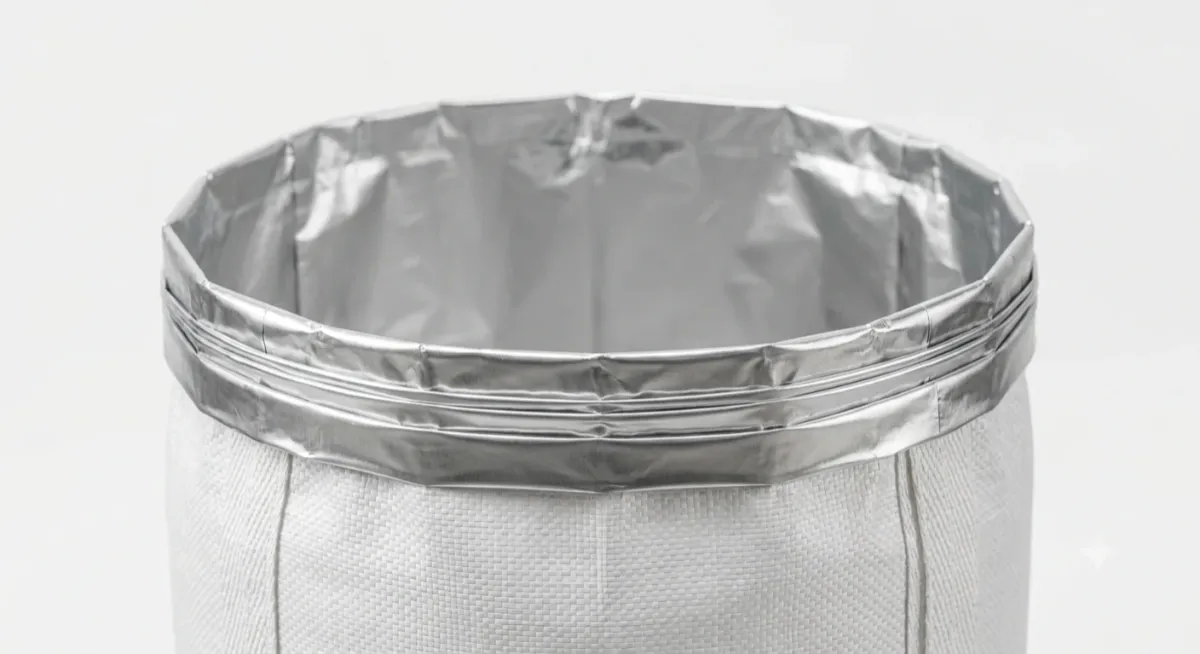
A liner is a separate inner bag fitted inside the woven FIBC. For food and pharma it is often the most important part of the specification, because the liner is what actually touches the product.
Liner | What it does | Typical use |
|---|---|---|
LDPE | Moisture barrier and a clean contact layer | Sugar, salt, dry ingredients that absorb moisture |
Aluminium | Strong barrier to moisture and oxygen | Food and pharma products that need high protection |
EVOH multi-layer | High oxygen barrier | Oxygen-sensitive food ingredients |
Conductive | Static control | Powders where static discharge is a risk |
On Shish bags, aluminium and EVOH liners are the recommended options for food-grade use where moisture and oxygen barriers are needed. LDPE liners suit moisture-sensitive products, and anti-static options are available for powders that build up charge.
Three liner points are worth checking before you order:
Fit. A liner that is too loose can twist and trap product; one that is too tight can tear when filled. Liners are made to match the bag's dimensions.
Fixing. Ask how the liner is held in place during filling and discharge so it does not pull out with the product.
Spouts. The liner needs spouts that match the bag's filling and discharge spouts, sealed so product cannot escape between liner and fabric.
Static: an overlooked risk with food powders
Fine dry powders such as flour, sugar, starch and milk powder can build up static electricity as they flow into or out of a bag. In a dusty or flammable atmosphere, a spark can ignite the dust.
That is why food plants handling fine powders often specify conductive (Type C) bags or anti-static coatings, with proper earthing during filling and discharge. The static type is a separate decision from food-grade status, and a bag can need both. Our FIBC types guide explains Types A, B, C and D in detail.
Single-use is usually the rule
Most food and pharma buyers specify single-trip (5:1) bags. Reusing a bag for food creates risks that are hard to control: residue from the last load, cleaning chemicals, moisture and damage that cannot be seen.
Some closed-loop systems do reuse 6:1 bags for the same food product, with strict cleaning and inspection. If you are considering that, read our explainer on the FIBC safety factor, 5:1 vs 6:1 first, and confirm that your own food-safety system and your customers allow it.
What to ask a food-grade FIBC supplier
Before you order, ask for:
The BRCGS certificate. Check the scope covers the bags you are buying and that the certificate is current.
Raw material confirmation. Virgin polypropylene for the fabric, and food-suitable material for the liner.
A written specification for every bag: SWL, safety factor, dimensions, body type, top and bottom construction, liner type and loops.
Traceability marking. A batch or production code on every bag, so a problem can be traced back.
Packing method. How the bags are baled, wrapped and protected for delivery.
Inspection records for the batch.
A label on every bag showing SWL and safety factor.
If a supplier cannot answer these clearly, the bag may be clean, but it is not food-grade in any sense your auditor will accept.
Common mistakes
Assuming "new" means "food-grade". A new bag made in an uncontrolled factory can still carry dust, threads or contamination.
Specifying the bag but not the liner. For many food products the liner is the food-contact surface. Specify it as carefully as the bag.
Forgetting static. Fine powders can create a static hazard regardless of the food-grade rating.
Reusing single-trip bags. A 5:1 bag is designed for one journey, and reuse also undermines hygiene.
Storing bags badly on site. A food-grade bag stored open in a dusty warehouse is no longer food-grade when you use it. Keep bales wrapped, dry and off the floor until use.
Shish food-grade FIBC bags
Shish manufactures FIBC bulk bags in Gujarat from virgin woven polypropylene, with SWL from 500 to 2,000 kg and 5:1 or 6:1 safety factors. Constructions include U-panel, circular, baffle, conductive (Type C), food clean and UN bags, with dust-proof seams, document pockets and printing available. Liner options include LDPE, aluminium, EVOH and conductive. FIBC production is BRCGS certified. Full specifications are on the FIBC bulk bags page.
Frequently asked questions
What is a food-grade FIBC bag?
It is a bulk bag made from food-suitable materials, such as virgin polypropylene, and produced under a certified hygiene and food-safety system so that it is safe for direct contact with food or pharmaceutical ingredients.
Is BRCGS certification required for food-grade bulk bags?
It is not a legal requirement in every market, but many food manufacturers and retailers require their packaging suppliers to hold BRCGS or a similar certified food-safety standard. It is the most direct way for a buyer to verify the supplier's hygiene and traceability.
Which liner is best for food products?
It depends on the product. LDPE gives a clean moisture barrier for dry ingredients such as sugar and salt. Aluminium and EVOH liners are better where the product also needs protection from oxygen.
Can food-grade FIBCs be reused?
Most food and pharma buyers use single-trip bags. Reuse is only possible with 6:1 bags in a closed-loop system with strict cleaning and inspection, and only if your food-safety system allows it.
Do food powders need anti-static bags?
Fine powders such as flour, sugar and starch can build up static charge. If there is a dust or flammable atmosphere, a conductive (Type C) bag or an anti-static option with proper earthing is often needed.
What should be printed on a food-grade FIBC?
At minimum, the Safe Working Load, safety factor, manufacturer and a batch or production code for traceability. Many buyers also specify their own product and handling information.
Get a food-grade FIBC specified
Tell us your product, the weight per bag, how the bags are filled and emptied, and whether static is a risk on your line. Our team will recommend the bag body, liner and safety factor, and quote against a written specification.
Request a food-grade FIBC specification and quote
Or speak to the team through the contact page.
